THE ASIAN INDEPENDENT UK

Bal Ram Sampla
Geopolitics
In the spring of 2020, images of hundreds of thousands of migrant workers trudging down Indian highways — hungry, exhausted, some carrying children — shocked the nation and the world. The COVID-19 pandemic had, overnight, stripped away their livelihoods and left them stranded in cities that suddenly offered nothing but danger.
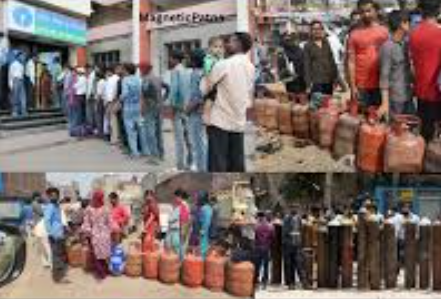
Six years later, eerily similar scenes are unfolding at railway stations in Delhi, Mumbai, Surat, and Hyderabad. This time, the trigger is not a virus but an LPG cooking gas crisis — a shortage rooted in the West Asia conflict that has sent global energy supply chains into disarray. Once again, India’s migrant workers are the first to suffer and the last to be protected. That this crisis has been allowed to escalate to the point of reverse migration — for the second time in six years — is not merely a policy failure. It is a systemic indictment of how India treats its most economically vulnerable citizens.
The Crisis Itself: More Than a Supply Problem
On the surface, the LPG shortage is a geopolitical misfortune. India imports approximately 60 per cent of its liquefied petroleum gas, the majority of it sourced from West Asia. The ongoing conflict in that region has disrupted global energy supply chains, tightening availability and driving prices sharply upward.
What is not understandable — and not unavoidable — is the speed with which this supply disruption translated into an crisis for India’s lowest-income workers. Migrant labourers earning between “₹500 and ₹800 per day found themselves unable to afford LPG refills that were being sold on the black market at ₹450–₹500 per kilogram”. For a daily wage earner, the choice between cooking gas and food is not a manageable inconvenience — it is an impossible contradiction. Without gas, there is no cooking. Without cooking, there is no affordable meal. Without affordable meals, there is no reason to remain in the city.
Over 150,000 workers reportedly left Surat alone within 30 days. Railway stations across the country filled with workers and their families, bags in hand, heading back to villages they had once left in search of a better life. The crisis had moved, swiftly and brutally, from a supply chain issue to a humanitarian one.
The Government’s Response: Too Little, Too Late
The Indian government’s handling of this crisis deserves scrutiny. Its initial posture was one of reassurance rather than action — officials insisted there was no shortage, that supplies were adequate, and attributed long queues at gas distribution centres to “panic ordering” by citizens. This response was not only inadequate; it was insulting to the millions experiencing real scarcity on the ground.
Framing the crisis as one of consumer behaviour rather than structural supply failure allowed the government to deflect accountability.
Substantive measures did eventually follow, but the timeline reveals a troubling pattern.
Commercial LPG allocation was raised to 50 per cent on March 21st — weeks after the crisis had begun. It was raised again to 70 per cent on March 27th. The allocation limit for 5-kg free trade cylinders for migrant workers was only doubled on April 7th — by which point tens of thousands of workers had already left cities. Each measure was delayed. A government failed to anticipate the downstream human cost of global energy disruptions far sooner, given that India has been on notice about its LPG import dependency for years.
The COVID Parallel: A Failure to Learn
The comparison to the COVID-19 migrant crisis is not merely rhetorical — it is structurally apt. In 2020, a sudden shock (the pandemic lockdown) exposed the complete absence of any safety net for India’s migrant labour force. Workers were stranded without wages, food, shelter, or transport. The images of that exodus became symbols of the state’s failure to account for the 54 million inter-state migrants — a number analysts believe has grown significantly since the 2011 census — who constitute the backbone of India’s urban economy.
In the aftermath of 2020, there were policy discussions: about social benefits, about migrant worker registration, about emergency employment guarantees that could function in cities, not just rural areas.
The One Nation One Ration Card scheme was held up as a model. Promises were made.
Six years later, the same workers are once again walking away from the same cities because the state failed to provide a basic necessity — affordable cooking fuel — and offered no meaningful alternative when it became scarce.
The alternatives are stark:
(1) Firewood and coal are unsafe in cramped urban slums.
(2) Electric stoves require stable power connections that shared accommodations in informal settlements rarely have
(3) Safer induction cookers are unaffordable on daily wages.
The structural vulnerabilities exposed in 2020 were never meaningfully addressed. The COVID crisis was treated as an aberration rather than a diagnosis.
The Human Cost That Does Not Make Headlines
It is worth dwelling on what reverse migration actually means for the individuals involved.
Ramnaresh Yadav, an autorickshaw driver who spoke to the BBC, sold his vehicle before returning to his village. That autorickshaw was not merely transport — it was his livelihood, the instrument of his economic independence. Its loss is not easily reversed. When the gas supply normalises, he will return to square one. Others face the prospect of enrolling children — settled into urban schools— back into village schools, disrupting educational continuity in ways that may have lasting consequences.
For women like Zareena Khatun, a domestic worker in Delhi, the crisis compounds existing insecurity and instability. Those who stay do so by exhausting savings, reducing meals.
Industry and business owners are also absorbing costs that will ultimately be passed down. Hotels, restaurants, construction sites, and small manufacturers depend on migrant labour. Labour shortages are already visible in these sectors. The Confederation of Indian Industry has warned that continued reverse migration will significantly damage micro, small and medium enterprises — the engines of employment creation in India.
Structural Failures Beneath the Immediate Crisis
The LPG crisis is a symptom of deeper structural failures that demand critical attention:
1. India’s dangerous dependence on LPG imports — 60 per cent sourced primarily from a region in active conflict — was a known and documented risk. The absence of serious investment in ‘diversification of energy sources for low-income households, including expanded piped natural gas networks and affordable electric cooking infrastructure, reflects decades of policy inertia’. The government’s belated suggestion that households should shift from LPG to PNG (piped natural gas) is an admission that the LPG model is fragile — but it comes after the crisis, not before it.
2. The informal status of migrant workers in India’s cities continues to be a source of vulnerability. Without documentation, they cannot access official gas connections. Without registration in urban systems, they are invisible to welfare mechanisms. The One Nation One Ration Card, while a step forward, does not cover cooking fuel.
3. The absence of a responsive early warning system for migrant worker welfare is glaring. The government did not act until workers were visibly leaving. There was no mechanism — no local governance structure, no employer obligation, no civil society network with state backing — that flagged the crisis early and triggered preventive action.
Conclusion: The Recurring Betrayal
India’s migrant workers do not ask for charity. They build the buildings, cook the food, staff the workshops, clean the homes, and drive the vehicles of a nation aspiring to be a global economic power. They ask only to be able to survive in the cities where they work — to cook a meal, to feed a child, to plan a future.
That this “elementary ask should be rendered impossible — not once, but twice in six years, by crises of different types but identical structural causes — is a betrayal that demands more than sympathy”.
It demands accountability:
(I) for the failure to build an energy system resilient enough to withstand foreseeable shocks
(II) for the failure to register, document, and protect a workforce of tens of millions
(III) for the failure to learn from 2020
(IV) for the reflexive instinct, visible again in 2026, to reassure rather than act when the most vulnerable are the first to suffer.
India must decide, finally and urgently, whether its migrant workers are citizens deserving of protection, or merely labour to be summoned and abandoned as geopolitical weather permits.
References
1.https://share.google/7qzJ37Zd1g0jogUMv
2.https://www.business-standard.com/industry/news/lpg-shortage-india-west-asia-conflict-migrant-workers-delhi-mumbai-surat-126040200877_1.html
3.https://www.businesstoday.in/india/story/no-way-to-cook-lpg-shortage-forces-out-migrant-workers-from-cities-amid-west-asia-war-524091-2026-04-05
4.https://www.india.com/news/india/lpg-crisis-india-migrant-workers-leaving-cities-gas-shortage-cooking-fuel-price-rise-jobs-impact-urban-migration-energy-crisis-8368130/
5.https://article.wn.com/view/2026/04/04/Soaring_LPG_prices_force_migrant_workers_to_leave_Indian_cit/