

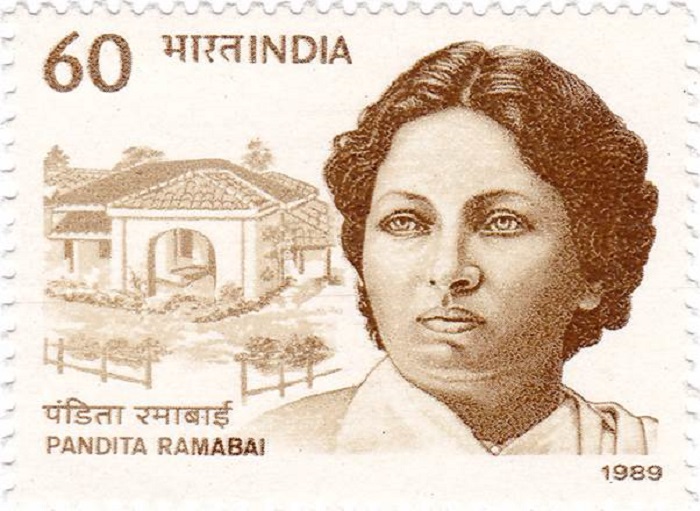
(Special on Jayanti of Pandita Ramabai)
SR Darapuri I.P.S. (Retd)
Introduction

(Asian independent) The late nineteenth century in India was marked by intense debates over the relationship between social reform, religion, and nationalism. Within this intellectual and political milieu, Pandita Ramabai (23 April,1858–5 April,1922) emerged as a pioneering yet controversial figure. A Sanskrit scholar, social reformer, and later a Christian convert, Ramabai articulated one of the earliest systematic critiques of gender inequality within Hindu society. Her work, particularly The High-Caste Hindu Woman (1887), exposed the structural oppression of women, especially child widows.
However, her critique provoked sharp opposition from leading nationalist figures such as Bal Gangadhar Tilak and drew critical responses from Swami Vivekananda. This essay examines Ramabai’s life, mission, and ideas, and analyses why her work was perceived as threatening by orthodox Hindu leaders.
Life and Intellectual Formation
Pandita Ramabai was born into a Chitpavan Brahmin family in 1858. Her father, Anant Shastri, defied social conventions by educating her in Sanskrit, a domain traditionally reserved for men. This early exposure to sacred texts enabled her to later critique Hindu religious traditions from within.
Following the death of her parents during the famine of the 1870s, Ramabai travelled widely across India. These travels exposed her to the harsh realities of women’s lives—especially those of widows, who faced social exclusion, economic deprivation, and religiously sanctioned suffering. Her scholarship earned her recognition in Calcutta, where she was conferred the titles “Pandita” and “Saraswati.”
Her personal life further shaped her reformist outlook. Her inter-caste marriage and early widowhood brought her into direct confrontation with the oppressive structures she later critiqued. These experiences transformed her into a committed advocate of women’s emancipation.
Critique of Brahmanical Patriarchy
Ramabai’s most influential work, The High-Caste Hindu Woman (1887), provides a detailed analysis of the structural subordination of women in Hindu society. She argued that religion permeated every aspect of social life, making it impossible to separate social practices from religious sanction. As she observed, “there is not an act that is not performed religiously.” ¹
This insight allowed her to advance a radical argument: that the oppression of women was not merely social but deeply embedded in religious doctrine and practice. Drawing upon texts such as the Manusmriti, she demonstrated how women were placed under perpetual male authority—first under the father, then the husband, and finally the son.
Ramabai was particularly critical of child marriage, which she saw as a root cause of women’s suffering. Early marriage deprived girls of education, exposed them to premature motherhood, and often resulted in early widowhood. Widows, especially child widows, endured extreme forms of social exclusion. They were subjected to harsh ascetic practices, denied property rights, and stigmatized as inauspicious.
She also highlighted the systematic denial of education to women, arguing that ignorance was deliberately maintained to sustain patriarchal control. Education, in her view, was essential for women’s liberation and self-respect.
Reformist Mission and Institutional Work
Unlike many critics of her time, Ramabai combined intellectual critique with practical reform. She established institutions such as Sharada Sadan in Bombay (later Pune) and the Mukti Mission at Kedgaon. These institutions aimed to provide: Education, Vocational training and Shelter for widows and destitute women
Her approach differed significantly from earlier reformers. Rather than seeking to reintegrate women into traditional family structures, she emphasized autonomy, dignity, and self-reliance.
Ramabai also engaged in transnational advocacy. Her travels to England and the United States enabled her to raise funds and mobilize support for her work. However, this international engagement also exposed her to criticism from nationalist leaders, who viewed such activities as reinforcing colonial stereotypes about Indian society.
Conversion to Christianity and Its Implications
Ramabai’s conversion to Christianity in 1883 marked a turning point in her life and career. While she remained critical of Western missionary paternalism, she found in Christianity a framework that emphasized spiritual equality and compassion.
However, her conversion became one of the primary reasons for opposition from Hindu orthodox leaders. It was seen not merely as a personal religious choice but as a political act that aligned her with colonial and missionary interests. Her institutions, especially those that provided refuge to widows, were accused of facilitating religious conversion.
Opposition from Bal Gangadhar Tilak
The opposition of Bal Gangadhar Tilak must be understood within the broader framework of cultural nationalism. Tilak believed that social reform should not undermine national unity or weaken resistance to colonial rule.
Through his editorials in Kesari, Tilak criticized reformers who, in his view, relied on colonial support or missionary backing. He opposed legislative interventions such as the Age of Consent Act (1891), arguing that they represented colonial interference in Indian society. ²
Ramabai’s critique of Hindu social practices—especially when articulated before Western audiences—was perceived by Tilak as damaging to the image of Hindu society. He viewed her work as contributing to colonial narratives that justified British rule.
Tilak also upheld traditional gender roles, emphasizing the importance of women’s domestic responsibilities. In this context, Ramabai’s advocacy of women’s education, independence, and public participation appeared radical and destabilizing.
Critique from Swami Vivekananda
The response of Swami Vivekananda was more nuanced. Vivekananda supported women’s education and acknowledged the need for social reform. He famously stated that “there is no chance for the welfare of the world unless the condition of women is improved.” ³
However, he differed from Ramabai in his approach. Vivekananda emphasized reform from within Hinduism rather than external critique. He argued that Hindu philosophy contained the resources necessary for social transformation and rejected the idea that the religion itself was fundamentally oppressive.
Vivekananda was also critical of Christian missionary activity, which he saw as a form of cultural imperialism. Ramabai’s conversion and her association with missionary networks were therefore viewed with suspicion. He believed that presenting Hindu society negatively to Western audiences undermined national self-confidence and cultural pride.
The Core Ideological Conflict
The conflict between Ramabai and her critics reflects deeper ideological tensions in colonial India.
First, there was a divergence between social reform and political nationalism. While Ramabai prioritized the emancipation of women and the transformation of social structures, Tilak emphasized the importance of political unity and resistance to colonial rule.
Second, there was a fundamental disagreement over the role of religion. Ramabai viewed religious texts and traditions as sources of oppression, while Vivekananda regarded them as resources for reform.
Third, there was a contrast between transnational and indigenous approaches. Ramabai’s global advocacy contrasted with nationalist concerns about cultural autonomy and self-representation.
Conclusion
Pandita Ramabai remains one of the most significant figures in the history of Indian social reform. Her critique of Brahmanical patriarchy, her commitment to women’s education and empowerment, and her willingness to challenge entrenched social norms set her apart as a radical thinker of her time.
The opposition she faced from Bal Gangadhar Tilak and Swami Vivekananda was rooted not merely in personal disagreement but in fundamentally different visions of society, religion, and nationhood. These debates continue to resonate in contemporary discussions on gender, religion, and social justice in India.
Ramabai’s legacy lies in her insistence that true freedom must include social equality and gender justice, a vision that remains relevant even today.
References
- Ramabai, Pandita. The High-Caste Hindu Woman. Philadelphia, 1887.
- Rao, Parimala V. “Tilak and Social Reform.” Indian Historical Review 35, no. 2 (2008): 215–240.
- Vivekananda, Swami. The Complete Works of Swami Vivekananda. Vol. 5. Calcutta: Advaita Ashrama.
- Forbes, Geraldine. Women in Modern India. Cambridge University Press, 1996.
- Chakravarti, Uma. Gendering Caste. Permanent Black, 2003.