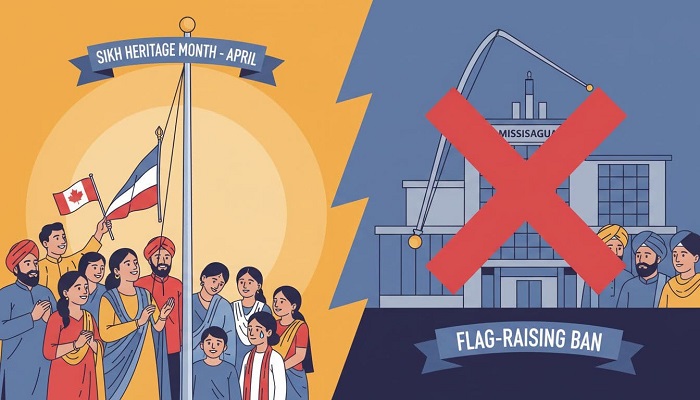

(Asian independent) A flagpole can look simply, but it often carries a city’s toughest choices. In April 2026, Mississauga Mayor Carolyn Parrish said on X that council had approved a motion to stop raising any national flag other than Canada’s on the city flagpole. Parrish said the pole was originally intended for charities and associations. That turns a symbolic issue into a clear civic policy change, and one with cultural and political weight. Mississauga City Council has ended ceremonial raisings of other countries’ national or religious flags at City Hall. Going forward, requests to fly foreign national flags for heritage months, independence days, or similar events will no longer be approved. The move follows a similar decision in Toronto, which recently stopped the same practice. In that sense, Mississauga is not acting alone. It is part of a wider GTA shift toward tighter rules around public symbols on civic property. Parrish framed the change as a statement about shared identity. She wrote that residents come from many parts of the world and leave old conflicts behind to become Canadians. “Our citizens come from all over the world, leaving conflicts to become Canadians.” She also said new Canadians with proof of a Mississauga address could pick up a free full-sized Canadian flag at City Hall the following week. Parrish’s message was direct. In her view, the City Hall flagpole was meant for charities and associations, not for foreign governments or national symbols. That marks a real shift in how Mississauga uses civic space. A pole once used for global recognition will now be tied more closely to local civic purpose. The decision also drew attention because an Israeli flag raising had been expected later in April. That gave the motion immediate context, even as the city framed the change as a broad rule, not a one-off response. The timing lands in a meaningful month for many families. April is Sikh Heritage Month in Canada, and Vaisakhi is observed on 14 April. For Sikh communities, this season often brings public celebrations, prayers, and visible symbols of faith and identity. So, even though the new rule is not aimed at one group, it arrives when questions of recognition can feel more personal. Vaisakhi recalls a defining moment in 1699 at Anandpur Sahib. Guru Gobind Singh created the Khalsa through the Amrit (Baptised) Sanchar ceremony and called Sikhs to live with courage, equality, faith, and service. The story of the Panj Pyare, the first five beloved ones, still matters because it represents commitment, sacrifice, and unity. Khalsa symbols are not simple decoration. The Five Ks means to the Sikh way of life, identity, and devotion. The five Ks are Kesh (uncut hair), Kara (steel bracelet), Kanga (wooden comb), Kachera (cotton undergarment), and Kirpan (ceremonial sword) reflect discipline, justice, self-control, and spiritual strength. That’s why public symbols during this month can carry deep meaning, far beyond a formal flag raising. While, Mississauga council’s flag decision has stirred debate during Sikh Heritage Month, when many Sikh residents expected Sikh flag to be raised in a show of civic respect. For the community, the flag marks more than a ceremony, because it recognizes Sikh contributions to Canada and gives families, including Canadian-born generations, a clear sense of pride, belonging, and visibility. It also honors the birth of the Khalsa and helps teach the public about Sikh values, faith, and service. However, the council’s move has drawn criticism from those who say the city missed a meaningful chance to reflect Mississauga’s diverse identity. As a result, the dispute has become a broader conversation about representation, public symbols, and how cities choose to honor communities that shape Canada’s cultural mosaic. Mississauga has not yet offered a full public replacement for international recognition at City Hall. For now, the revised April 2026 policy points the flagpole back to charities and non-profit groups, not foreign nations. Some residents will see that as a push for unity under the Canadian flag. Others may worry it narrows public recognition of heritage communities. Either way, Mississauga has redrawn the line. The city has chosen Canada’s flag as the only national symbol for that pole, and the debate over belonging, identity, and civic space is unlikely to fade soon.