THE ASIAN INDEPENDENT UK

Bal Ram Sampla
Geopolitics
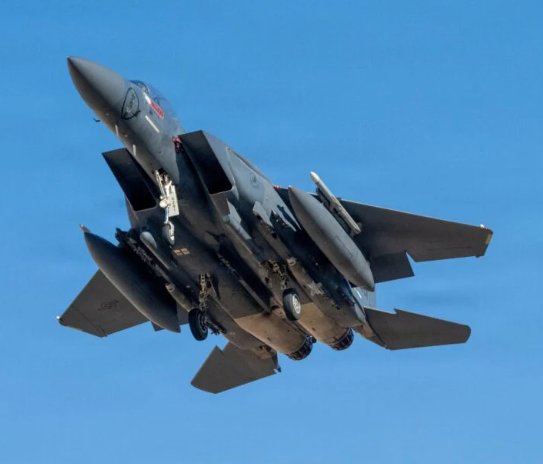
On April 3, 2026, the United States suffered its first confirmed loss of a manned aircraft to enemy fire since the Iran war began in late February. An F-15E Strike Eagle — a two-seat fighter jet capable of both air-to-air and ground-attack missions — was shot down over Iran. One of its two crew members, a pilot and a weapons systems officer, was rescued by U.S. special forces. The other remains missing.
Social media reports initially described the aircraft as an F-16, but multiple U.S. officials confirmed the plane was an F-15E, assigned to the 494th Fighter Squadron normally based at RAF Lakenheath in England. Iran’s Islamic Revolutionary Guard Corps claimed credit for the shootdown, saying it used a new, advanced air defense system — a significant claim given that President Trump and Defense Secretary Pete Hegseth had repeatedly insisted that Iran’s air defenses had been largely destroyed.
“After defeating Iran 37 times in a row, this brilliant no-strategy war has now been downgraded from ‘regime change’ to ‘Hey! Can anyone find our pilots?'” — Mohammad Bagher Ghalibaf, Speaker of Iran’s Parliament.
The rescue operation was intense and dangerous. Video geolocated by CNN showed U.S. aircraft and helicopters flying at low altitude over Khuzestan Province in broad daylight — deep inside hostile territory. A U.S. Black Hawk helicopter involved in the search was hit by Iranian ground fire, though the crew was reported safe and the aircraft able to fly.
A separate A-10 Warthog also went down near the Strait of Hormuz around the same time; that pilot was safely recovered. Iran, meanwhile, flooded the area with troops and broadcast appeals on state television asking civilians to capture any American airmen, promising cash rewards.
Israel, which has been conducting its own strikes on Iran as part of the joint campaign, suspended planned airstrikes in areas relevant to the rescue effort so as not to hamper U.S. search operations. Israel also shared intelligence with the U.S. to help locate the missing crew member.
The most pressing question is whether this changes the diplomatic picture. On the surface, Trump says no. When asked directly by NBC News if the shootdown would affect negotiations with Iran, he was blunt: “No, not at all. No, it’s war. We’re in war.” The White House offered little else publicly, with Trump spending the day in the Oval Office receiving briefings rather than speaking to reporters.
But the reality on the ground is more complicated. Iran rejected a U.S. proposal for a 48-hour ceasefire on the same day, calling it a sign of American weakness. At the same time, former Iranian Foreign Minister Mohammad Javad Zarif published an article in Foreign Affairs magazine suggesting Iran would be willing to limit its nuclear program and reopen the Strait of Hormuz in exchange for the lifting of all sanctions — a rare public signal of potential compromise from the Iranian side.
The fate of the missing second crew member may prove to be the most important factor of all. If captured, that airman could become a bargaining chip in any future peace talks — giving Iran significant leverage at the negotiating table. Analysts have pointed out that Iran is a vast country, making a successful rescue in remote, mountainous terrain extraordinarily difficult.
Since the war began on February 28, over 1,900 Iranians have been killed. Trump has said he expects the campaign to wrap up within two to three weeks.
U.S. and Israeli strikes have hit bridges, infrastructure, and Iranian military sites. Iran has retaliated with missile and drone attacks on Gulf states including the UAE, Kuwait, Saudi Arabia, and Bahrain. Russia and Turkey jointly called for an immediate ceasefire. Oil prices rose further on news of the escalation. The war, which began just five weeks ago, is showing no signs of a quick resolution — despite the White House’s optimistic framing.
What started as a mission described as “nearing completion” now faces a far more volatile reality. One American airman is safely home. Another is somewhere in Iran, and both sides are searching for him — for very different reasons.
Based on reporting from CBS News, CNN, NBC News, and The Jerusalem Post — April 3, 2026.