THE ASIAN INDEPENDENT UK

Bal Ram Sampla
Geopolitics
What PMQs Is Supposed to Be
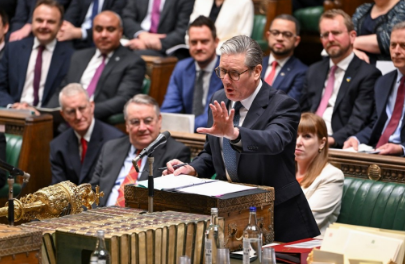
Every Wednesday at noon, the Prime Minister stands up in the House of Commons and faces questions from MPs. It is called Prime Minister’s Questions — PMQs for short — and it is one of the most watched moments in British political life. For thirty minutes, the leader of the country is supposed to be held to account. No notes, no teleprompter, just the cut and thrust of parliamentary democracy at work.
The idea is simple. MPs ask questions. The Prime Minister answers them. The public gets to see whether their leader can think on their feet, defend their decisions, and engage honestly with the people who represent millions of voters across the country.
Under Keir Starmer, that idea has become a distant memory.
The Red Folder and the Pre-Scripted Dodge
Week after week, Starmer arrives at the despatch box clutching his red folder. Inside are not thoughtful responses to the issues of the day — they are pre-written attack lines, rehearsed in private with aides who play-act as the opposition. Whatever question is thrown at him, Starmer reaches into the folder and pulls out something that was written hours before the session even began.
The result is surreal to watch. Ask him about Peter Mandelson’s links to Jeffrey Epstein — and he answers about the war in Iran. Ask again — and he attacks the shadow justice secretary. Ask a third time — and he starts talking about protests in London. The question never gets answered. The subject is always changed. And the red folder stays firmly gripped.
Conservative MP Andrew Snowden put it bluntly and publicly when he told the chamber: “Every week the Prime Minister comes here and reads out this pre-scripted nonsense that bears no resemblance to the questions he is actually asked.”
It is hard to argue with that assessment.
Even Parliament Had to Change the Language
Things became so visibly absurd that even Parliament’s own official social media account quietly changed how it described what was happening. For months it had been posting that Starmer had “answered questions” at PMQs. Then, in a telling moment that did not go unnoticed, the wording changed. Now Starmer merely “faced questions.”
This is not a small thing. When Parliament’s own communications team can no longer bring itself to claim the Prime Minister has “answered” anything, it tells you everything you need to know about the state of accountability in this country.
The Mandelson Debacle — A Case Study in Evasion
The session of March 2026 became the most glaring example yet. Tory leader Kemi Badenoch had one clear question: did Starmer personally speak to Peter Mandelson before appointing him as British Ambassador to Washington? It was a straightforward, reasonable question. Mandelson had by this point been sacked after the full extent of his links to convicted paedophile Jeffrey Epstein were revealed. The public deserved a straight answer.
She asked six times. Six times, no answer came. Instead, the Prime Minister reached into his folder and offered attacks on Badenoch’s position on Iran, criticism of a Tory frontbencher’s tweet, and a lecture on military decision-making. The chamber grew increasingly restless. Even loyal MPs on Starmer’s own benches shifted uncomfortably in their seats.
At one point, the atmosphere became so heated that Speaker Sir Lindsay Hoyle felt compelled to tell the House — twice — that he was “not responsible for the answers.” It was a remarkable admission from the chair. Even the Speaker had effectively thrown up his hands.
A Man More Comfortable Lecturing Than Listening
There is a pattern to Starmer’s PMQs performances that has become very familiar. When cornered on a difficult question, he does not try to answer it — he turns it into an opportunity to tell the opposition how badly they would have done things. He lectures. He pontificates. He reminds everyone in the room how terrible the previous government was.
It might be a useful tactic once or twice. Deployed every single week, it has become insufferable. More importantly, it has stopped being effective. When a Prime Minister routinely answers the question he wishes he had been asked rather than the one he was actually asked, something has gone badly wrong.
Starmer has also changed the opening of PMQs itself, using the traditional “engagements” question — once a brief formality — to deliver a lengthy, partisan statement each week. He is, in effect, turning the start of PMQs into a second government press briefing. It is clever in a narrow political sense.
Why This Actually Matters
Some will shrug and say this is just politics. All Prime Ministers dodge questions. Tony Blair did it. David Cameron did it. They are all as bad as each other.
That is true up to a point. But there is a difference between occasionally sidestepping an uncomfortable question and turning evasion into the entire strategy. Starmer has taken avoidance to an industrial scale. His advisors have, it seems, decided that turning up with a folder full of attack lines is safer than genuine engagement. And so week after week, the chamber is treated to theatre instead of accountability.
PMQs matters because it is one of the few moments in our democracy when the most powerful person in the country cannot simply hide behind a statement or a press secretary. They have to stand up, in person, and face the music. When that process is hollowed out, something real is lost — not just for politicians, but for the millions of ordinary people whose only visibility into government is what they see on their television screens on a Wednesday lunchtime.
What Could Be Done
There are no easy fixes. The Speaker has no power to force a Prime Minister to give a substantive answer — his role is procedural, not editorial. He can tell MPs to sit down, but he cannot compel the person standing up to actually say something meaningful.
Some have suggested giving the Speaker new powers to formally rule an answer “non-responsive” and require the PM to try again. It is an interesting idea, though it would represent a major constitutional change and would face fierce resistance from any government in power.
A mass walkout by opposition MPs has also been floated. The gesture would be dramatic, but it risks handing the government a free run of the chamber and could easily be spun as petulance rather than principle.
In the end, the most powerful tool remains political embarrassment. When Andrew Snowden’s short speech went viral, it reached far more people than the session itself. When clips of Badenoch asking the same question six times spread across social media, voters could see exactly what was happening with their own eyes. Starmer’s evasions are becoming a story in their own right — and that may ultimately prove more damaging than any direct answer could have been.
A Chamber in Need of Respect
The House of Commons is one of the oldest democratic institutions in the world. For centuries it has been the place where governments are held to account, where power is questioned, and where the people’s representatives can demand answers from those who govern them.
Keir Starmer is not the first Prime Minister to treat PMQs as a performance to be managed rather than an obligation to be met honestly. But under his watch, the gap between what the session is meant to be and what it has actually become has grown wider than most people can remember.
The red folder sits on the despatch box. The scripted lines get delivered. The questions go unanswered. And every Wednesday, a little more of the public’s faith in their democracy quietly drains away.
That should concern every one of us — regardless of which party we support.
References
1.https://www.ibtimes.co.uk/parliament-quietly-changes-how-it-describes-keir-starmer-pm-faces-no-substance-slurs-1771494
2.https://www.huffingtonpost.co.uk/entry/keir-starmer-repeatedly-dodges-mandelson-questions-in-bizarre-pmqs-performance_uk_69ba98d7e4b09c2b7ebfa323
3. https://spectator.com/article/pmqs-was-ruined-by-starmers-verbal-epilepsy/
4.https://constitution-unit.com/2025/04/23/how-has-keir-starmer-changed-prime-ministers-questions/