THE ASIAN INDEPENDENT UK

Bal Ram Sampla
Geopolitics
In March 2026, a Pakistani airstrike on Kabul killed hundreds of people. The strike hit what the Afghan Taliban called a hospital for drug rehabilitation patients. Pakistan said it was targeting a military installation used to manufacture suicide drones. Both things, it turns out, may be true — and that is what makes this story so complicated.
This explains what happened, why it happened, and what we still do not know.
How the War Started
The conflict did not begin with the hospital strike. It began weeks earlier, in late February 2026, when Pakistan launched airstrikes inside Afghan territory. Pakistan said it was targeting camps used by the Pakistani Taliban — a militant group known as the TTP — as well as ISIS-K fighters. These groups had been responsible for deadly attacks inside Pakistan, including bombings in Islamabad, Bajaur, and Bannu.
The Afghan Taliban, who now govern Afghanistan, responded furiously. They launched their own airstrikes and drone attacks against Pakistani military targets. The two sides began exchanging blows across the border, and within weeks the situation had escalated into what Pakistan itself described as an open war.
The Drone Strikes on Rawalpindi
A key turning point came when Taliban forces launched drones toward several Pakistani cities — including Rawalpindi, home to Pakistan’s military headquarters, known as GHQ. The drones were intercepted and shot down, but their targets sent a clear message: the Taliban were willing to strike at the heart of the Pakistani military.
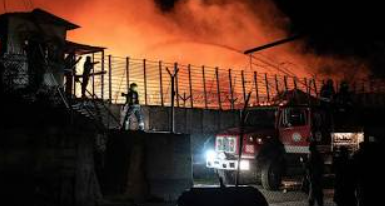
Pakistan’s president said the Taliban had “crossed a red line.” The Pakistani Air Force responded with a new wave of strikes — and one of them hit the Omid facility in Kabul on the night of March 16.
What Was Actually Hit?
This is where the story gets murky. The Taliban said the strike hit the Omid Hospital, a 2,000-bed facility treating people recovering from drug addiction. They reported around 400 people killed — a devastating figure that shocked the world.
Pakistan rejected this entirely. It said it had only struck military installations and released video footage showing secondary explosions — the kind that happen when weapons stockpiles are hit, not hospital wards.
An investigation by Afghanistan International then added a crucial detail: the site in question was Camp Phoenix, a former NATO base. About a decade ago, part of it was converted into the Omid drug rehabilitation centre. But for around three years, the Taliban had also been operating a suicide drone manufacturing facility inside the same compound. Local residents referred to the whole place as “Omid Camp” — which is why the two sides were arguing over the same location with completely different names.
Deliberate Attack or Intelligence Failure?
Given what we know, the most likely explanation is neither a deliberate massacre nor a simple intelligence failure. It is something more troubling: a strike on a dual-use site, where a legitimate military target and a civilian facility occupied the same space.
Under international law, deliberately placing military assets inside civilian facilities — such as hospitals — is considered using human shields. If the Taliban knowingly manufactured drones inside a rehabilitation centre full of patients, that would be a war crime on their part.
But international law also requires attacking forces to take all feasible precautions to protect civilians and to weigh the expected civilian harm against the military advantage gained. If Pakistan knew — or should have known — that thousands of vulnerable people were inside that compound, then questions about proportionality arise on their side too.
It is worth noting that the United Nations did not say the hospital was “directly targeted.” Its statement said the drug treatment facility was “affected” by the strike — a careful word that leaves open the possibility it was collateral damage rather than the intended aim.
What We Still Do Not Know
The death toll itself is disputed. The Taliban claimed around 400 dead. The UN said “dozens” were killed or wounded and has not released a precise figure. The true number almost certainly lies somewhere between those two accounts, but an independent investigation has not yet concluded.
China sent a special envoy to mediate between the two countries. International calls for a ceasefire have gone unheeded. As of the time of writing, the conflict continues.
Conclusion
The Kabul hospital strike is not a simple story of good versus evil. It is a story of two countries locked in escalating violence, of military assets hidden in civilian spaces, and of the terrible cost paid by ordinary people — patients in a hospital, residents near a base — who had no part in starting this war.
Both sides bear responsibility. The Taliban, for embedding a weapons factory inside a rehabilitation centre. Pakistan, for striking a compound where the presence of vulnerable civilians was at least foreseeable. And the broader international community, for allowing a conflict on the Afghanistan-Pakistan border — one of the most volatile regions on earth — to reach this point without effective intervention.
The UN has called for an independent investigation. Until that investigation reports its findings, the full truth of what happened on the night of March 16, 2026 remains contested. What is not contested is that many people died — and that a war nobody seems able to stop is still going on.
References
1.https://youtu.be/JsoohTUK8hQ?si=gDL9gMtGRG60NQrq
2.https://www.tribuneindia.com/news/pakistan/400-people-killed-in-pakistan-strike-on-afghanistan-hospital-treating-drug-users/
3.https://www.washingtonpost.com/world/2026/03/17/afghanistan-pakistan-conflict-kabul-airstrike-hospital/4d0615ac-21d1-11f1-954a-6300919c9854_story.html
4.https://edition.cnn.com/2026/03/16/asia/pakistan-afghanistan-strike-hospital-latam-intl
5.https://edition.cnn.com/2026/03/16/asia/pakistan-afghanistan-strike-hospital-latam-intl
6.https://www.journal-advocate.com/2026/03/17/kabul-hospital-airstrike/