SAMAJ WEEKLY UK

Bal Ram Sampla
Geopolitics
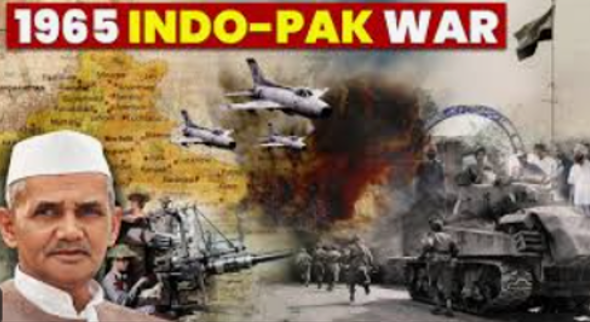
In September 1965, tanks rolled through the Punjab plains in one of the largest armoured battles since World War II. India and Pakistan were at war.
This article looks at how America helped build Pakistan’s war machine — not through secret back-channels, but openly and deliberately — and how that decision changed the history of South Asia forever.
1. The Alliance That Started It All
To understand 1965, you have to go back to 1954. The Cold War was at its peak. Washington was desperate to contain communism in Asia, and Pakistan — strategically positioned between the Soviet Union, China, and the Middle East — was exactly the partner America was looking for.
Pakistan signed a Mutual Defense Assistance Agreement with the United States in 1954, then joined two Western military alliances: SEATO (Southeast Asia Treaty Organization) and CENTO (the Baghdad Pact). In Washington’s eyes, Pakistan was a loyal anti-communist bulwark. The reward was generous — military hardware, training, and money, all paid for by American taxpayers.
Over the next decade, the United States poured approximately $700 million in military aid into Pakistan. By 1965, America accounted for more than 53% of all of Pakistan’s arms imports. Pakistan’s army, air force, and navy were, in large part, American-equipped.
2. What America Gave Pakistan
The weapons Washington supplied were not just rifles and jeeps. Pakistan received some of the most advanced military technology of the era:
M47 and M48 Patton Tanks — These American-made tanks formed the backbone of Pakistan’s armoured divisions. During the 1965 war, they clashed directly with Indian forces in the Battle of Asal Uttar and the Battle of Chawinda — some of the fiercest tank engagements since WWII. India captured dozens of them, and several are still on display as war trophies.
F-86 Sabre and F-104 Starfighter Jets — Pakistan’s air force flew American fighter jets. The F-104 Starfighter, in particular, was a supersonic aircraft that gave Pakistan a significant aerial edge. Pakistani pilots, many trained in the United States, used these planes in dogfights against Indian aircraft.
Artillery, Communications Equipment, and Logistics — American aid also covered artillery pieces, radar systems, and the logistical infrastructure that allowed Pakistan to mobilise a modern fighting force.
3. India’s Outrage and America’s Promise Broken
When the war broke out, India was furious. Ambassador B.K. Nehru marched into the office of US Secretary of State Dean Rusk and delivered a formal protest. India’s argument was simple and powerful: America had promised the weapons were for defence against communism — not for use against a neighbour.
India pointed to a specific assurance given by President Eisenhower in 1954, when the aid agreement was signed. Eisenhower had personally assured India’s Prime Minister Nehru that American weapons would never be turned against India. That promise now lay in ruins on the battlefield.
Washington’s response was awkward. The Americans could not deny that their tanks were fighting India. But neither could they openly admit they had armed one nation to fight another friendly country. The diplomatic embarrassment was enormous.
4. America Cuts Off Pakistan Mid-War
Here is where the story takes a surprising turn. Once the war actually began, the United States did NOT send fresh weapons to Pakistan. Instead, Washington imposed an arms embargo on both countries.
Why? Because the Johnson administration discovered that Pakistan had started the war — specifically through Operation Gibraltar, a covert infiltration of Kashmir using soldiers disguised as civilians. American officials felt deceived. They had given Pakistan weapons for defence, and Pakistan had used them to launch an offensive.
The embargo technically applied to both but the impact fell far harder on Pakistan. India had begun to diversify its arms sources, partly due to its 1962 war with China. Pakistan, by contrast, was almost entirely dependent on American supplies. When the tap was turned off, Pakistan felt it acutely — ammunition reserves ran low, replacement parts dried up, and the military momentum stalled.
5. The Consequences That Echoed for Decades
The 1965 war and America’s behaviour during it reshaped South Asian geopolitics in ways that are still felt today.
Pakistan felt betrayed. Islamabad had believed America was a reliable security partner. The arms cutoff shattered that faith. Pakistan began looking elsewhere — to China, which stepped in to fill the gap, and this deepened the Sino-Pakistani friendship that continues to define regional politics today.
India pivoted to the Soviet Union. Having seen how American arms were used against it, and having been refused Western weapons during the war, India dramatically accelerated its military relationship with Moscow. By the late 1960s, over 80% of India’s arms came from the Soviet Union — a fact that would prove decisive in the 1971 war.
The arms race intensified. Rather than bringing stability, American weapons introduced an arms race into South Asia that neither side could easily escape. Each war left both nations more determined to build larger, more sophisticated militaries — a spiral that ultimately led both countries to nuclear weapons.
Conclusion: Cold War logic
The American arming of Pakistan before 1965 was not a secret conspiracy or a covert operation. It was an open policy, driven by “Cold War logic”: keep Pakistan in the Western camp, contain communism, and build a military ally in a volatile region.
What Washington failed to account for was that the guns it provided would be used not against Soviet tanks but against Indian soldiers in a war over Kashmir. When that happened, America found itself in an impossible position — having armed a conflict it didn’t want, between two countries it had to manage.
The lesson of 1965 is one that Cold War historians return to again and again: when great powers arm smaller nations in pursuit of global strategy, they often lose control of how those weapons are used. The United States gave Pakistan the tools of modern war. What it could not give was the wisdom about when — and against whom — to use them.
References
1.india-Pakistan War of 1965.
https://history.state.gov/milestones/1961-1968/india-pakistan-war
2. Christine Fair, Fighting To The End: Pakistan’s army way of war. (2014).
3.https://www.eurasiareview.com/09092025-1965-war-us-arms-for-pakistan-used-for-aggression-against-india-oped/
4.https://history.state.gov/historicaldocuments/frus1964-68v25/d259
5.https://www.stimson.org/2023/25-years-of-security-cooperation-beneath-the-nuclear-shadow/