THE ASIAN INDEPENDENT UK

Bal Ram Sampla
Geopolitics
Something remarkable happened in the world of sport. Fourteen of cricket’s most celebrated former captains — from India, Australia, England, the West Indies, and New Zealand — set aside national rivalries, political neutrality, and the customary silence of sporting figures on matters of governance, to sign a joint petition addressed to Pakistan’s Prime Minister Shehbaz Sharif.
Their subject: the treatment and detention conditions of Imran Khan, Pakistan’s former Prime Minister and one of cricket’s most towering figures.
The petition, organised by former Australian captain Greg Chappell, was not a political manifesto. It was, in the words of its signatories, “made in the spirit of sportsmanship and common humanity, without prejudice to any legal proceedings.”
And yet its very existence — the sight of Sunil Gavaskar and Kapil Dev, men who once duelled against Khan in fierce Test matches, standing alongside Michael Atherton, Clive Lloyd, and Allan Border to demand humane treatment for a political prisoner — carried enormous moral weight. It also raised profound questions about the role of sport, solidarity, and conscience in international affairs.
Imran Khan
To understand the significance of this petition, one must first appreciate who Imran Khan is — not merely as a politician, but as a cricketer. Born in 1952 in Lahore, Khan rose to become one of the finest all-rounders the sport has ever produced. A genuine pace bowler of fearsome quality and a forceful lower-order batsman, he played 88 Test matches for Pakistan, taking 362 wickets and scoring over 3,000 runs.
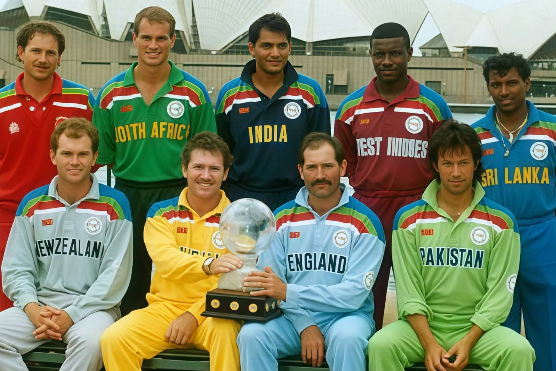
His greatest hour came in 1992, when he captained Pakistan to their only Cricket World Cup victory, a triumph built on improbable resilience after a rocky start to the tournament. His pre-tournament declaration — that he would “fight like a cornered tiger” — became one of the most quoted phrases in cricket history. For Pakistanis and cricket fans alike, that World Cup win was not merely a sporting achievement; it was a source of immense national pride.
After retiring from cricket, Khan entered politics and, in 2018, was elected Prime Minister of Pakistan. His tenure was contentious, as most are, but he had been chosen democratically by the Pakistani electorate — a fact the petitioners were careful to note. In April 2022, he was removed from office through a vote of no confidence. The political turbulence that followed led to his arrest in 2023, and by the time the petition was written, he had been incarcerated for over two and a half years.
The Petition: What It Said and Why It Mattered
The text of the petition was measured and careful. The signatories were not calling for Khan’s release or declaring him innocent of any charges. They were not adjudicating on Pakistan’s domestic legal matters. What they asked for was far more fundamental: proper medical care, humane conditions of detention, and fair access to legal processes.
The urgency was driven, in particular, by alarming reports about Khan’s health. According to his family and supporters, he had lost approximately 85 percent of the vision in his right eye while in custody. This, combined with broader concerns about his living conditions, led the former captains to conclude that a line had been crossed — that the treatment of this particular prisoner had fallen below the standards of basic dignity.
The petition appealed to three specific actions from the Pakistani government: immediate access to qualified medical specialists of Khan’s choosing; humane and dignified detention conditions in accordance with international standards, including regular family visits; and transparent, unhindered access to legal processes.
Framed in the language of sport, the letter invoked cricket’s values of fair play and respect. “Cricket has long been a bridge between nations,” the petition noted. “Our shared history on the field reminds us that rivalry ends when the stumps are drawn, and respect endures.” It was a deliberate and telling choice of language — an appeal to something the signatories knew their audience understood, because it was the same code they had all lived by.
A Remarkable Coalition
The fourteen names beneath the petition represented some of the most distinguished careers in cricket history. From India came Sunil Gavaskar, perhaps the greatest opening batsman of his era, and Kapil Dev, the charismatic all-rounder who led India to their first World Cup in 1983. From Australia came Allan Border, Greg Chappell, Ian Chappell, Kim Hughes, and Stephen Waugh — men who collectively spanned four decades of Australian dominance. England was represented by Michael Atherton, Michael Brearley, David Gower, and Nasser Hussain. Clive Lloyd brought the authority of one of West Indies cricket’s greatest leaders, while Belinda Clark — the legendary Australian women’s captain — and John Wright of New Zealand completed the group.
What is striking is not just the individual prestige of these names but the breadth of the coalition. They came from nations with vastly different relationships with Pakistan, different political cultures, and different histories. Several of them had faced Imran Khan on the pitch and knew his combative, uncompromising spirit firsthand. Sunil Gavaskar made this personal dimension explicit in a statement accompanying the petition: “It’s terrible what they are doing to him. We have been friends since he was trying to qualify as an overseas player for Worcestershire, and not just rivals on the field.”
That Gavaskar — an Indian cricketing icon — would speak so warmly and so publicly about Khan, a Pakistani, in a period of historically strained India-Pakistan relations, speaks volumes. It is a reminder that the bonds forged between competitors on a cricket field can transcend borders and political divisions in ways that formal diplomacy often cannot.
A Long Tradition
The cricketers’ petition belongs to a long and sometimes uncomfortable tradition of athletes speaking out on matters of human rights and political conscience. It is a tradition that has not always been welcomed.
In cricket itself, perhaps the most famous precedent is the campaign against apartheid South Africa. For decades, international cricketers and administrators faced intense pressure — and sometimes imposed it themselves — over whether to tour or play against South Africa.
I remember, The D’Oliveira affair of 1968, when England’s selectors controversially omitted Basil D’Oliveira from their touring party to South Africa, became a defining moment in the intersection of sport and politics. Ultimately, South Africa was banned from international cricket for over two decades — a ban that many historians regard as one of sport’s most effective contributions to political change.
The petition for Imran Khan is notable precisely because it did not try to do too much. Its signatories were not endorsing his politics, demanding his acquittal, or calling for regime change in Pakistan. They were making a modest, humane request — that a fellow human being, and a cricketing legend, be treated with basic dignity while in custody. This restraint likely made the petition more effective, not less. By keeping their demands narrow and grounded in universal principles, the fourteen cricketers made it harder for the Pakistani government to dismiss their appeal as foreign interference in domestic affairs.
The Response and Its Significance
The petition attracted significant international attention. It came alongside expressions of concern from organisations including Amnesty International, Human Rights Watch, and the International Federation of Human Rights, all of which had raised questions about the fairness of Khan’s trial and the conditions of his imprisonment.
Pakistan’s government did not publicly welcome the petition. Official responses tended to frame the matter as an internal legal affair, outside the purview of foreign commentators, however eminent. This was predictable, and the petitioners likely anticipated it. The value of such an appeal is not always measured in immediate policy change. Sometimes it lies in the moral record — in making clear, for history, that the world was watching and that prominent voices, from multiple nations and walks of life, had spoken.
For Imran Khan’s supporters within Pakistan and in the Pakistani diaspora around the world, the petition carried enormous symbolic significance. It represented an assertion, from voices the Pakistani establishment could not easily dismiss as hostile, that the treatment of their leader had crossed a line. And for the international community, it served as a reminder that the Imran Khan case was not merely a domestic Pakistani matter, but a question with implications for democratic norms, the rule of law, and the treatment of political prisoners more broadly.
The Power of Sporting Brotherhood
There is something deeply human about the petition that Chappell, Gavaskar, Lloyd, and their fellow captains placed before Pakistan’s Prime Minister. In their words, one hears an echo of the values that sport, at its best, instils: that opponents deserve respect, that fair play extends beyond the boundary, and that the bonds formed in competition — in the heat of a Test match, on the fields of England, Australia, the Caribbean, and the subcontinent — do not dissolve when the game ends.
Cricket, as the petition noted, has long been a bridge between nations. On this occasion, fourteen of its greatest servants chose to use that bridge not to celebrate the game they love, but to call for something the game has always taught: that however fiercely you compete, you do not lose sight of your common humanity.
References
1.https://www.newswire.lk/2026/02/17/gavaskar-kapil-among-14-ex-captains-appeal-for-fair-treatment-of-imran-khan/
2.https://www.india.com/sports/imran-khan-jail-treatment-sunil-gavaskar-kapil-dev-among-14-legendary-cricket-captains-urging-pakistan-govt-8310805/
3.https://crictoday.com/cricket/news/sunil-gavaskar-kapil-dev-request-pakistan-government-to-give-fair-treatment-to-imran-khan/
4.https://www.business-standard.com/cricket/news/gavaskar-kapil-dev-lead-appeal-to-pak-govt-for-imran-khan-s-fair-treatment-126021700779_1.html
5.https://www.espncricinfo.com/story/sunil-gavaskar-greg-chappell-among-14-former-captains-to-come-out-in-support-of-imran-khan-1524694