
THE ASIAN INDEPENDENT UK
 – Prof K.S. Chalam
Chairman, Institute for Economic and Social Justice,
Ex Member, Union Public Service Commission,
Former Vice Chancellor Dravidian University, Kuppam
(Andhra Pradesh)
[email protected]
Conversation is an age-old method of conversing with people either to elucidate a point or extract information. India is one of the earliest regions in the World in the practice of oral tradition to converse with what is called ‘Guru-Shisya samvad’. In the western tradition, Socratic Method is cited as one of the oldest methods of dialectical reasoning but, India had the tradition of dialectics of conversation as a method of debating issues deep in philosophical discourse. In fact, the whole collection of Upanishad literature was in the form of conversation. In Chandyog Upanishad one can find the debate on materialism conversed between Uddalaka Aruni and Swetaketu. It is cited here to mention that Vidya Bhushan Rawat an activist scholar with his deep commitment to marginalized groups and love for knowledge from below made him to adopt this technique. He has used the techniques to collect colossal data and information across the continents particularly from South Asia. It is generally World institutes like the World Bank or World Bank sponsored researchers with huge funding and staff usually collects such data and publishes reports or books. Here is a single individual like a Gipsy moved around physically and used ICT facilities like Zoom, Email etc to collect this information and the results are published in 3 Volumes.
1. Contesting Marginalization-Conversations on Ambedkarism and Social Justice. 2 Contesting Marginalization-Conversations on Social Justice, Identities and Resource Rights. 3. Periyar: Caste, Nation and Socialism, an Innovative Approach to Commemorate a Movement. There are 21 conversations with activists, scholars and civil society workers in the first volume, 22 experts, academics, civil society workers who have entrenched association with victims of the system in the Second volume. The Third conversation is about Periyar movement that has set the tone for a social revolution in South Asia with a scholar activist. All the three volumes are published by People’s Literature Publication, Mumbai-Pune.
 The first volume has set the agenda of the conversation with an objective to build knowledge about marginalization in South Asia, the mother of all unnatural and inhuman structures of exploitation and an institution designed to permanently isolate groups of humans in their homeland by aliens. The volume is dedicated to five important scholars and fighters of dalit cause, who had admiration for Babasaheb Ambedkar. Some of them have worked with him. Late Bhagwan Das, L.R. Balley, V.T Rajasekhar, R.M. Pal and N.G. Uke. Except late Uke, I had the opportunity to interact with all the other great crusaders of social justice in India. Before the publication of Babasaheb Writings and Speeches by the Maharashtra Government, it was the volumes of Bhagawan Das, ‘Thus Spoke Babasaheb’ were the only sources of his writings and intellectual caliber. In fact, Bhagwan Das had an intellectual and social interaction with him both as his follower and also as an officer working with him compared to Ratthu who was Babasaheb’s Typist. Rawat noted in his introduction, “Bhagwan Das ji was also well known through his enormous work of bringing out the Ambedkar volume. Whenever I went to him, I would just want to listen to him numerous anecdotes and stories about Dr Ambedkar. Some of them were so interesting and important that I felt that they should have come in the book form but I was not a publisher so one day I felt that it is time we need to record conversations with all those people who are working for the cause of human rights, secularism and Ambedkarism.” The author has explained the method and manner in which he obtained the information, the initial drive to draw the respondents reply and the warmth he has created to drive deep in to the conversation to elicit some inconvenient answers also. It needs thorough study and understanding of the life and works of the person being interviewed and which Rawat did in his analysis and presentation of the matter. It is indicated that sometimes he lost the tapes, papers and recreated them by using all kinds of techniques are really important for scholars who conduct field work and the kind of ethnographical work done by university scholars. I think Rawat has acquired all these skills through trial and error and his profound commitment for the work he was doing. One can notice how the author was devoted to Ambedkar and his mission in the process of his getting in to the job of writing the conversations after finishing the collection of questionnaires or tapes or direct interactions and the notes taken while conducting personal interactions. It appears that no single individual has so far done this kind of a work in too many areas and with so many great souls who were and have been involved in the crusade against casteism, fundamentalism and social inequity. The author has combined scholarly approach with lucid literary narrative of the subject that makes the reader not only entertaining but also helps to get knowledge about the subject. I wish that Rawat should venture in to literary activities as a creative writer to indicate the prowess of real subaltern writing about the marginalized in particular and the World in general in future.
Volume I starts with Bhagawan Das followed by L.R. Balley both of them have known Babasaheb in person. Mr Uke was promoted by Babasaheb in sponsoring him for foreign studies and helping him to get a job. He started the Ambedkar Samaj organization first time. N.G. Uke was also part of the Scheduled caste Student Federation. He was of the opinion that the creamy layer of the Dalits is the cream of the Dalits and no one can take away that property as it belongs to the community to lead the crusade. The conspiracy of creamy layer appears to be a ploy to deprive the Dalits of capable leadership; the issue of creamy layer is brought. Each conversation can be extended in to a separate chapter or book as some of the conversations are intense and keep the readers engaged. It is interesting that Bhagwan das started as a junior in the Supreme Court with Senior advocate P.P. Rao who was a Lohia-ite and a committed Telugu upper caste gentleman who worked for the Dalits by conviction. Bhagwan Das clarified that both Nehru and Ambedkar were Fabian Socialists and have mutual respect. Balley was a rebel and a fierce person when I met him in the 1980s had contributed to Ambekarism through his ‘Bhim Patrika’ and other publications. V.T Rajasekhar was one of the very few non-Dalits who started a Journal in the name of Dalit Voice first time in India. He had encountered several hurdles in life both as a journalist and as a secular activist in India. It was Rajasekhar who has revealed the fact that the title for his Journal Dalit Voice was actually suggested by eminent Novelist Mulk Raj Anand. R. M. Pal as a human rights activist was close to M.N.Roy and V M Tarkunde. He promoted the ideology of Babasaheb and the civil rights movement both during emergency and after. R M Pal has brought out the fact that Ambedkar as Member of Viceroy’s Council (Labour Minister) has paid money from the exchequer to M.N.Roy for attending conferences was close to him.
The works of Vijay Surwade made Babasaheb alive in his photos and other clippings to make a museum. He is the only person with the largest number of collections of Babasaheb belongings etc., in India. He has narrated the relationship between Babasaheb and Savita Kabir and the letters that they had exchanged were available with him. He has given his personal interaction with Nanak Rattu whom he considered is of a low caliber selfish person in creating stories against Savita Ambedkar, who he felt had ulterior motives to grab property and, in a way, responsible for getting the things out of control when the owners of 26 Alipore Road approached for settlement. The conversations with the Dalt Panthers leader Raja Dhale, is interesting as he had seen Babasaheb in his childhood. He was inspired by the Black Panthers of USA by reading Magazines like Time, Newsweek at that time. How Namadeo Dhasal, Ramdas Athawale and others left and joined Shiv Sena or associated with them, was narrated by him. He was of the opinion that ‘paper Buddhists’ are of no use and unless backward classes are also brought in to the Buddhist movement, nothing changes. He wanted to link Phule-Ambedkar and Marx. Another Maharashtra Intellectual who is a family member of Babasaheb Ambedkar is Anand Teltumbde. He has a different trajectory of defending Babasaheb by looking in to his activist and intellectual encounters to project him as a pro left statesman. He is the one who is very critical about Dalit Formation and the struggles in India with a close proximity to Maharashtra and Mahar experience. He is not happy with Ambedkar Bhakti. He has also critically examined the RPI formation and the splits. He has however agreed that BSP, DMK etc have achieved some electoral victories. It is natural for Anand being a human rights activist to look at the incident in Nagpur where some Ambedkarites raised slogans against the Pro Naxalite Intellectual Saibaba with contempt. His analysis of Ambedkar Economics was sketchy and may be not aware of the fact that Ambedkar was one of the earliest to have started a discussion on a two-sector model of development and his concept of state socialism. Anand is critical about the role of RSS and how it was trying to coopt Dr Ambedkar in to their cohorts. He agrees that the idea of Bahujan is acceptable provided it is a combination of all sarvajan and not only few groups. That limits his criticism about Babasaheb.
A.K Biswas was not clear about the role of Babasaheb in the context of Jogendranath Mandal. He was very forthright about the marginalization of Namasudras and other Dalits in the left front government in Bengal including the massacre of Marichizapi. Some of his comments on the popular reformist figures of Bengal like Eswar Chandra Vidyasagar, Ashutosh Mukherjee are revealing and showed the darker side of the personalities mostly Brahmin Bhadralok.
Rawat has also interacted with non-Dalit Adivasi, OBC intellectuals and leaders in his conversations. Prominent among them are Rajadurai, Geetha, Bhadant Nagraj Surai, R M Pal and Anand Patwardan. In addition to the Indian activists, he has brought in the intellectual flavor from abroad including Dalit activists in the United Kingdom, African American professor Kevin Brown and senior Dalit activists from Nepal. The section on Adivasi or tribal groups mostly of North East and Chakma of Bangladesh touched very important issues of South Asia that are not generally flagged in Dalit or Bahujan discourse of activists and intellectuals. That appears to be as per the perception of Adivasi activists is a great weakness of Ambedkar movement. The Nepali inputs are an eye opener as the Left in Nepal is not very far from Indian Left in terms of conceptualization of class and caste relations except repeating Marxist jargon. However, Tilak Pariyar, the then Central Committee Member and Secretary of Communist Party of Nepali Maoist, was right in saying that untouchability and right to land are complimentary. He said that, ‘caste system is also a product of class divided society. Thus, the fact is proved that the problem of caste system and untouchability is a form of class exploitation and oppression. It is notable that the whole and parts have dialectical relation; the whole gets completeness only after integrating several parts. To talk about pure class liberation or pure Dalit liberation in isolation means to serve the status-quo.’ This kind of analysis is hardly seen among Indian Communists including Dalits. Pariyar has suffered untouchability in his childhood and through hard work reached the highest position in the party with a total understanding of the Nepal society and the contradictions. Another Nepal Dalit activist Omprakash Gahatraj reiterated that no Buddhist in Nepal ever taken the responsibility of emancipation of Dalits. He confessed that he is influenced by Ambedkar’s Buddhist movement. The Japanese Buddhist convert Nagarjuna Surai explained his hallucinations in coming to Nagpur to serve the Buddhist cause.
Dalits in the UK are an important group today to reckon with as they have occupied important political positions like Mayors and Representatives in political parties. The story of Arunkumar is very interesting as he migrated from Punjab after finishing his P.G and serving as a clerk and facing discrimination in the department particularly from the Jat Sikhs. He has narrated how he has encountered the same problems in England. Bishan Das Bains was elected as Mayor of Wolverhampton as a member of the Labour Party. He has also narrated how fellow upper caste Indians played caste politics in the U.K and his valiant fight to get a Bill on Caste Discrimination in UK prepared and presented in Parliament. Santosh Das was a Health professional in the UK government and she was awarded Medal of the British Empire (MBE) by the Crown. She has been active in the UK along with other Ambedkarites including Ravidasi and Buddhist followers.
The question of indigenous people or tribals in Bangladesh’s Chittagong region has been well explained by M Chakma. The Chakmas faced oppression and isolation despite their participation in the Bangladesh liberation movement. They are butchered in geographical sense of separation and physical elimination as tribals of the region. They had problems both with the Rohingayas and the Muslim government of Bangladesh as the administration pushed Rohingyas into the indigenous people region creating a conflict between them and the intruding outsiders. Chakmas are Buddhist minority in Bangladesh. In fact, it was narrated in another context by a Buddhist scholar that Chakmas are the descendants of Sakyas to which group the Buddha belong.
The analysis of Prof Kevin Brown of Indiana University, USA is very interesting. He visited India as a Fulbright scholar in 1995 at National School of Law, Bangalore. He had very good relations with a Dalit Christian of the same university and has participated in some meetings perhaps to get firsthand experience of Dalits in India. It appears that he was not exposed to the real Dalit experiences. He was of the opinion that Gandhi was closer to Blacks than Ambedkar for the reason that Martin Luther King Jr. adopted Gandhian methods of non-violence. Though Malcolm X is discussed in academic circles, his influence among the Blacks is limited as a Muslim. He has explained that the Blacks in America as a segregated community utilized the condition to consolidate the Black community and strengthened social capital and expanded in different economic areas. Now the character of Blacks is undergoing a change as it is becoming a multiracial group due to interracial marriages. He has mentioned that there was a dearth of eligible black men to marry upward mobile Black women. The Whites have been marrying Black girls and of course have several problems of family break ups etc. that is not typical in the USA. Blacks have started their own universities and colleges and Prof Brown mentioned that there are more than 100 Black Presidents of Universities in the USA. It was due to Martin Luther King Jr. struggles, Blacks in America were close to Gandhi than to Ambedkar, though he was also known to some as a crusader of Caste discrimination in India. Rawat has collected data from him and tables are given in the text to show the economic status of Blacks in terms of per capita income etc. supplied by Brown. It was the Black Panthers movement in the USA that inspired the recent movement of “Black Lives Matter”. Brown has opinioned that Christianity was behind black’s struggle. Most of the young blacks are in jails as criminality is a constant factor among the Black ghettos. The conditions are now changing as the younger generation is of mixed race and is far better than India. India is a terrible place of Caste discrimination and he is of the opinion that Blacks and Dalits can find common ground of action to fight descent-based discrimination. M.C.Raj of Karnataka initiated in Tumkur is a unique movement for Dalit empowerment with the establishment of Booshakti Kendra, fighting for the land rights of the Dalits. He along with his wife Jyoti devoted their lives to create a community with self-sufficiency of panchayat based on cooperative living and got around 11000 acres for the Dalits from government. Raj has a different narrative of Ambedkar. He says that “ if Ambedkar saw Adijan history as a subjugated history, then I must say that his view was jinxed. Being subjugated is only one side of history. Ambedkar refused to see the strength of his people. Like many NGOs of today he could not wage a battle in society if he saw the brighter side of the Adijans. That’s why he could not sustain his negotiation on separate electorate. Instead, he surrendered to the idea of reserved seats. Pathos and ghetto are strong tools at the hands of Adijan leaders to promote themselves.” M.C.Raj has put all of his ideas in to practice in Tumkur. It appears that his critique of Babasaheb can be taken up as an interesting topic of research.
The above narrative of conversations meticulously recorded and put to writing byVidya Bhushan Rawat has a wide canvas to understand the problems of Dalits and the issue of Marginalization in South Asia. It is not a uniform kind of discrimination, dispossession and untouchability across the regions and social groups as seized or incarcerated in the term Dalit by several scholars and activists. It is a much spacious socio-economic and cultural and to some extent geographical issue if adivasis are also included in the group as marginalized group in South Asia. There is however a mechanism in the madness of caste discrimination that while the victims are varied but the tormenter or victimizer is the same across the subcontinent. The conversations amply demonstrate this important phenomenon.
 Volume 2 of the conversations is extensive and the issues are numerous brought under the wide net of social Justice, Identities and Resource Rights. Interestingly, the subjects of the study are the same people, the marginalized. Therefore, it broadly connects with the first volume where the focus is on Dalits and Ambedkar in South Asia and in this volume the important issue of Land Question is interrogated across the Globe except the developed world. Rawat has made use of his acquaintances of the Global Land Forum of Dakar, Senegal to connect with the victims of Africa, South America, South Asia, South East Asia and other countries. He has covered very huge clientele in these conversations covering around two dozen activists and experts on Land, Human Rights and Environment. In fact, these are issues around which people’s struggles around the World are engaged by both Marxist and Humanist groups. The writer Rawat notes that, “deeper understanding of the India’s social movements through the prism of Ambedkar-Phule-Periyar-Birsa, the icons of Dalit-Bahujan-Adivasi movement is the way forward. I feel that without social and cultural attachment with the communities we only become patrons and not part of the movement. For me Land and resource rights are not merely ‘economic’ issues as many thinks but the very identity of the communities and their culture as well.” In other words, Rawat is preoccupied with the question of Dalits in India and therefore trying to relate them with similar movements or epochs in other parts of the World is very important aspect of these writings for activists and researchers to consider as Bench Mark study to dwell deep in to the question of Marginalization, Exploitation and Underdevelopment today. That is the reason why he confesses that “it has been a satisfactory journey for me since I gave it a thought to work on this volume as I was able to get activists, thinkers, global leaders from so many countries and continent at one platform so that the readers enjoy the opinion and experiences from different part of the world. This diversity was the most powerful feature of International Land Coalition which taught me to respect and understand the local knowledge system.” There appears to be a lacuna in this as the Dalit and Ambedkar movements in India are without an economic agenda of emancipation while in the rest of the Global South oppressed are very clear about their priority of land and Resource questions. They have realized that unless the land and other resource rights issues are settled and the original owners or natives are restored their right to resources, the related issues of human rights and environment or climate can never be resolved to get the so-called social justice.
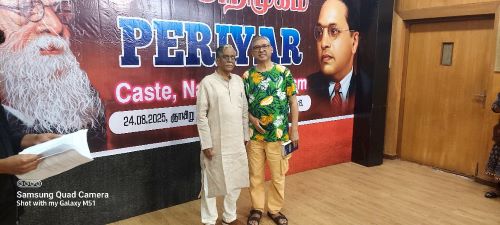
 Volume 3, ‘Periyar -Caste, Nation and Socialism, a conversation with S V Rajadurai’ an activist scholar of Dravidian movement is actually an Innovative Approach to Commemorate a Movement i.e. Self-Respect movement initiated by Periyar. The volume has brought in several issues not only for current debates on the relevance of Periyar in contemporary India, but also raised issues of inadequacy of the movement. Rawat has elicited important information relating to not only Dravidian movement and Periyar, but also raised controversial issues like Dalit massacres in Tamilnadu and the role of Periyar from Rajadurai. Thought it is a contentious issue, Rajadurai has tried to provide a convincing answer with a modest approval. The conversations flag that it is necessary to interrogate the source material for studies on non-Brahmin movement as most of it was made available by Brahmin translators in the past. The present Dravidian movement of Periyar was started during the period when the British Madras presidency was in position capturing the whole of South and the language groups. It is now confined to Tamilnadu and has remained narrow both in geographical terms and also ideological expanse of Dravida as the continuation of Indus and Harappa civilization. It needs intellectual collective efforts to bring in new approaches to study, reflect and expand issues of caste, class and their annihilation as enunciated both by Periyar and Ambedkar along with several leaders who sacrificed their lives to relieve the Native Indians from thralldom of wicked ‘Brahmanical Social Order’ and their well-entrenched machinations both in theory and practice. This volume provides sufficient ground to carry on the agenda of liberation of the native Indians, both social and economic from the exploitation by Brahmanical Hindus as well as the global capitalists.
The three important conversations undertaken by Vidya Bhushan Rawat is a gigantic academic exercise undertaken by a non- practicing scholar gypsy. The three volumes clearly indicate how Rawat has covered the globe with an inquisitive query of obtaining the nuances of Marginalization. The author has successfully extracted the dynamics of Marginalization across cultures, regions, environments and social settings. The merit of the exercise despite its craze for Ambedkar and untouchability is that it has identified the parameters of discrimination, deprivation and dispossession are common among untouchables, adivasis and other marginalized in South Asia in particular and in the third World non – communist countries in general. It appears that the author has limited accessibility to gender issues within the scope of these conversations which the author would include in his future adventures. The style is erudite and the narratives are fabled to make the readers comfortable through the pages.
Name of the books
Contesting Marginalisation: Conversations on Ambedkarism and Social Justice Vol 1 by
Vidya Bhushan Rawat
Contesting Marginalisation : Conversations on Social Justice, Identity and Resource Rights Vol II
By Vidya Bhushan Rawat
Periyar: Caste, Nation and Socialism : S V Rajadurai in conversation with Vidya Bhushan Rawat
All the above books are available on Amazon and Flipkart. You can also write to Mr Vivek Sakpal at [email protected] or contact him at 91-9004308889