THE ASIAN INDEPENDENT UK

Bal Ram Sampla
Geopolitics
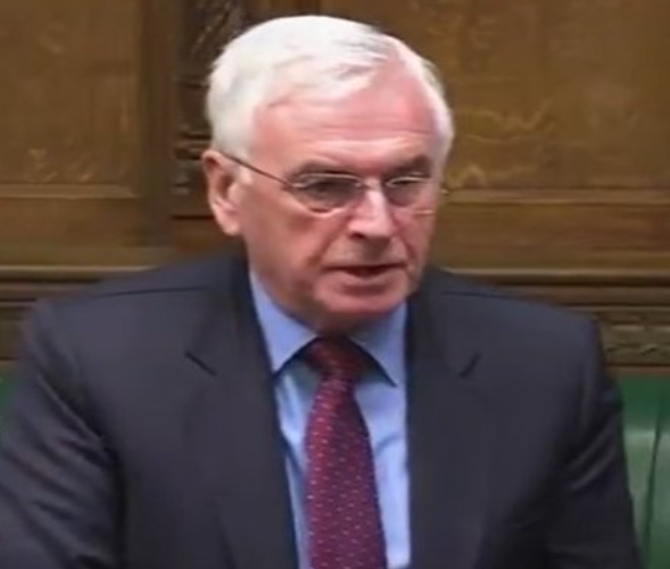
In late November 2025, Labour Member of Parliament John McDonnell tabled an Early Day Motion (EDM) in the British House of Commons that brought international parliamentary attention to a deeply troubling humanitarian crisis unfolding in Pakistan’s Balochistan province. This legislative action, though modest in its immediate powers, represents a significant moment in the international community’s engagement with human rights abuses in one of Pakistan’s most restive regions. McDonnell’s intervention illuminates both the gravity of the situation in Balochistan and the potential role that international legislatures can play in advocating for vulnerable populations.
McDonnell’s Early Day Motion was prompted by a series of deeply disturbing incidents that occurred in Balochistan during the autumn of 2025. The immediate was a drone strike on October 5, 2025, in Zehri, Khuzdar district, which reportedly claimed the lives of six civilians, including four children. This lethal military action against civilians epitomizes the dangers that ordinary Baloch people face in their daily lives, caught between insurgent activities and heavy-handed state security operations.
Beyond this tragic incident, the motion highlighted two particular cases of enforced disappearances. Mahjabeen Baloch, a student with disabilities, has been missing since May 29, 2025, while teenager Nasreena Baloch was abducted on November 22. These cases underscore a disturbing pattern in which Pakistani security forces allegedly target vulnerable individuals, including women, students, and minors, in their counter-insurgency operations.
The detention of five Baloch women by Pakistani security forces on November 17 further exemplified what the motion characterized as acts of collective punishment. This practice of detaining family members of suspected militants or activists represents a violation of fundamental principles of justice that hold individuals responsible only for their own actions, not those of their relatives.
The Content and Demands of the Motion
The Early Day Motion serves multiple functions within the parliamentary system. First, it formally records these concerns within the official proceedings of the House of Commons, creating a permanent legislative record of British parliamentary concern about human rights violations in Balochistan. This documentation itself holds diplomatic significance, as it demonstrates that Pakistan’s actions in the region are subject to international scrutiny and criticism.
The motion explicitly calls upon the UK Government to take stronger diplomatic measures in response to these developments. Importantly, it reminds government ministers of their previous assurances that human rights concerns in Balochistan have been raised with Pakistani officials. This aspect of the motion serves to hold the British government accountable for its own stated commitments to human rights advocacy and suggests that previous diplomatic interventions have been insufficient given the continuing and escalating nature of abuses.
Parliamentary Questions and UK Complicity Concerns
Accompanying the Early Day Motion, McDonnell submitted three written parliamentary questions that probe deeper into the UK’s relationship with Pakistan and potential British complicity in human rights abuses. These questions demonstrate a sophisticated understanding of how international military cooperation can inadvertently facilitate human rights violations.
The first question asks whether the Foreign Secretary has recently engaged Pakistani counterparts specifically on the escalating abuses in Balochistan. This inquiry seeks to establish whether human rights concerns are being actively and consistently raised at the highest diplomatic levels, or whether they are being sidelined in favor of other aspects of the UK-Pakistan relationship.
The second question, directed at the Department for Business and Trade, asks whether the government has evaluated the risk that UK-supplied equipment could be contributing to the documented abuses in Balochistan. This represents a crucial inquiry into supply chain accountability. If British technology or equipment is being used to facilitate enforced disappearances, drone strikes against civilians, or other human rights violations, the UK government bears some moral and potentially legal responsibility for these outcomes.
The third question examines whether any export licenses have been issued for military or dual-use items that could be employed in drone operations or internal security actions in Balochistan. This question addresses the specific concern about the October 5 drone strike and whether British technology may have played any role in enabling such operations. The inquiry into dual-use items is particularly astute, as such technology can ostensibly serve legitimate civilian purposes while also enhancing military capabilities.
The Broader Context of Baloch Suffering
To understand the significance of McDonnell’s intervention, one must appreciate the scale and severity of human rights abuses in Balochistan. According to a report by the Baloch Yakjehti Committee covering just September and October 2025, 168 victims of enforced disappearances were documented. Of these, merely twelve were released, seventeen were killed while in custody, and 140 remain missing to this day. These numbers represent more than statistics; they represent families torn apart, lives destroyed, and a climate of fear pervading Baloch society.
The geographical distribution of cases reveals the systematic nature of these abuses. Kech district recorded the highest number with 54 cases, followed by Panjgur with 26, Dera Bugti with 21, and Quetta with 20. This widespread distribution indicates that enforced disappearances are not isolated incidents but rather a pervasive pattern affecting the entire province.
The demographic profile of victims is particularly disturbing. The majority of those disappeared are young people between 19 and 25 years old, representing the future of Baloch society. Among the disappeared are 53 students, 21 minors, and at least one woman. The targeting of students suggests an attempt to suppress the educated class and potential future leadership of the Baloch people. The disappearance of minors represents a particularly grave violation of international humanitarian standards, which afford special protections to children.
Pakistan’s Frontier Corps has been identified as the largest perpetrator, involved in 45 percent of enforced disappearance cases, followed by the Counter-Terrorism Department and Military Intelligence. This indicates that human rights abuses are not the work of rogue elements but are being carried out by official state security institutions. The systematic involvement of multiple state agencies suggests institutional policies rather than isolated incidents of misconduct.
During the same two-month period, 25 cases of extrajudicial killings were recorded, including one minor and one woman among the victims. These killings represent the most extreme form of state violence, denying victims even the pretense of legal process or justice.
The Growing International Movement
McDonnell’s Early Day Motion did not emerge in isolation but represents part of a growing international awareness of and concern about the situation in Balochistan. According to reports, six British MPs in total—including Sam Carling, Sojan Joseph, Mike Martin, Jim Shannon, Kate Osamor, and McDonnell himself—have questioned the government about Pakistan’s human rights record regarding Balochistan.
This parliamentary attention has been largely driven by advocacy from the Baloch National Movement and other diaspora organizations that have worked tirelessly to bring international attention to their people’s plight. These groups face the challenge of raising awareness about a conflict that receives far less media coverage than other global human rights crises, partly due to Pakistan’s strategic importance to Western nations and partly due to Balochistan’s remote location.
The British Government is now formally obligated to respond to McDonnell’s written questions within three days, creating a concrete opportunity for public accountability and potentially influencing UK foreign policy toward Pakistan.
The Strategic Significance of Balochistan
Understanding the context of this crisis requires acknowledging Balochistan’s strategic and economic importance. The province is rich in natural resources, including natural gas, coal, copper, and other minerals. The deep-water port of Gwadar, developed with Chinese investment as part of the China-Pakistan Economic Corridor, has transformed Balochistan into a crucial node in regional geopolitics.
However, many Baloch people feel they have been excluded from the benefits of their province’s resource wealth, which is extracted and exported while the local population remains impoverished. Baloch nationalist movements have long argued for greater autonomy or even independence, leading to decades of insurgency and counter-insurgency operations.
The Pakistani state views Baloch separatist movements as existential threats to national integrity and has responded with increasingly militarized approaches to governance in the region. This has created a vicious cycle in which state repression fuels further alienation and resistance, which in turn prompts even harsher security measures.
The Role of International Parliamentary Advocacy
Early Day Motions in the British Parliament do not have binding legal force; they cannot compel the government to take specific actions. However, they serve several important functions. They create official records of parliamentary concern, can influence public opinion, generate media attention, and signal to foreign governments that their actions are being monitored by the international community.
For the Baloch people, McDonnell’s motion represents a form of recognition that their suffering is not invisible to the outside world. When victims of state violence see that members of foreign legislatures are willing to speak on their behalf, it can provide psychological and moral support during dark times.
Moreover, such parliamentary interventions can influence diplomatic relationships and government policy. While the UK government may prioritize its strategic relationship with Pakistan, documented evidence of parliamentary concern about human rights abuses creates political pressure for the Foreign Office to raise these issues in bilateral discussions. Over time, consistent international pressure can contribute to changes in state behavior, even if the effects are gradual and incremental.
The Question of Complicity
Perhaps the most significant aspect of McDonnell’s intervention is his probing of potential British complicity in Pakistani human rights abuses. Modern military operations rely heavily on sophisticated technology, and Western nations are major suppliers of such technology to Pakistan. If British-made equipment, components, or dual-use technology is being employed in operations that result in civilian casualties or facilitate enforced disappearances, questions of moral and legal responsibility arise.
The UK has established procedures for export control that are supposed to prevent British military technology from being used to violate human rights. However, these systems are only as effective as the scrutiny applied to them. McDonnell’s questions force the government to examine whether its export control mechanisms are working effectively or whether they require strengthening to prevent British technology from facilitating human rights abuses in Balochistan.
This line of inquiry also serves notice to the Pakistani government that its relationship with the UK could be affected if it is determined that British-supplied equipment is being misused. Such diplomatic signals, while subtle, can influence government behavior when combined with other forms of international pressure.
Conclusion
John McDonnell’s Early Day Motion on Balochistan represents a significant act of parliamentary solidarity with a marginalized and oppressed population. While the motion itself cannot directly stop enforced disappearances, prevent drone strikes, or secure the release of detained Baloch civilians, it serves crucial functions in documenting abuses, creating political pressure for diplomatic action, and demonstrating international concern for human rights.
The motion highlights several specific cases—the October 5 drone strike, the disappearances of Mahjabeen and Nasreena Baloch, and the detention of five Baloch women—giving names and faces to a humanitarian crisis that often remains abstract in international discourse. By doing so, McDonnell honors the dignity and humanity of the victims and challenges the British government to live up to its stated commitments to human rights advocacy.
As the UK Government prepares its mandatory responses to McDonnell’s written questions, the international community watches to see whether rhetoric about human rights will be matched by meaningful action. The people of Balochistan, meanwhile, continue to live with the daily reality of disappearances, extrajudicial killings, and military operations that show little distinction between militants and civilians.
McDonnell’s intervention reminds us that parliamentary democracy, at its best, provides a platform for the powerless to have their voices heard and their suffering acknowledged. Whether this acknowledgment will translate into substantive improvements in the lives of Baloch people remains to be seen, but the motion represents an important step in ensuring that their struggle is not forgotten by the international community.
References
1.https://www.tribuneindia.com/news/abductions/uk-parliamentarians-slam-pakistan-for-state-backed-abductions-drone-killings-in-balochistan
2.https://thenewsmill.com/2025/11/uk-parliamentarians-slam-pakistan-for-state-backed-abductions-drone-killings-in-balochistan/
3.https://www.newsonair.gov.in/uk-mp-john-mcdonnell-concerns-about-recent-human-rights-violations-by-pakistani-forces-in-balochistan/
4.https://edm.parliament.uk/early-day-motion/62404/human-rights-in-balochistan
5.https://edm.parliament.uk/early-day-motion/64620/human-rights-in-balochistan-no-3
6.https://www.parallelparliament.co.uk/mp/john-mcdonnell/debate/2024-02-20/commons/westminster-hall/balochistan-human-rights
7.https://ianslive.in/uk-mp-raises-concerns-over-abduction-of-baloch-women-use-of-drones-by-pak-forces-in-internal-security-operations–20251203162620