
Chandra Singh Garhwali deserve to be in our school text books so that generation learn his ideological traits and sacrifice for the country
Vidya Bhushan Rawat
THE ASIAN INDEPENDENT UK- India’s freedom movement have rarely acknowledged the heroism of those beyond the ruling elite particularly when they don’t hail from the ‘mainstream land’ or were not part of the Brahmanical elite who dominated the political discourse in India and thirdly, beyond the narrative of the Indian National Congress. Yes, Chandra Singh Garhwali, a poor man born in the Uttarakhand region was not a political activist but a Havildar of the Indian army but then why should he be celebrated ? Yes, that is the most important part that a non commissioned officer with his ‘no’ became the hero of the nation though even the military civilian leadership in India evaded those questions in the latter years. That apart, a hero like Garhwali was ignored by the people, got defeated in elections though being worshipped later.

Chandra Singh Garhwali was called the hero of ‘Peshawar revolt’ but frankly speaking our history books rarely mentioned about his heroism and the idealism behind it. He is merely referred as a person who refused to fire on the agitating Pathans of Peshawar. There have been no efforts made to understand about his life and time apart from even the local scholars have been least bothered about his ideological traits. Actually, the problem in our part of the world is rather than ideological traits people actually support or worship of hero because of his or her identity. So, Chandra Singh Garhwali’s identity as a person from Garhwal is the point in the hills but not his ideology and it is the same thing that even beyond Garhwal or Kumaon, his valour is not much known or celebrated.
Chandra Singh was born on December 25, 1891 in a village near Thailisain town in Garhwal, Uttarakhand. His father Jalauth Singh was an illiterate farmer. Life was extremely difficult for him living in the inaccessible terrain of the middle Himalayan region in Garhwal. Growing up, he had witnessed and experienced poverty and marginalization among the people who lived in the mountains. He joined the army at age 21 in 1914 at Lansdown as a soldier, which was common among the youth of the region. Garhwal and Kumaon remained outside the regulations of the British India, for a longer period and later they carefully recruited the people from these regions and used their services for British empire’s war in Europe, Africa as well as West Asia. Chandra Singh participated as a British Indian soldier during the World War 1 in 1915 and went to France and returned to India in 1916. He was a highly influenced by the Arya Samaj and equally respected Gandhi ji and the Indian National Congress’s struggle for our freedom, but his own thoughts and actions went far beyond these institutions and ideologies. He was a disciplined soldier but was a strong believer in democracy. He strongly supported and fought for communal harmony and social justice, and in an era of increasing communalization of the military, administration and media, his life and work are a important story that needs to be told and retold to our young children through school text books as well as in the university level too.
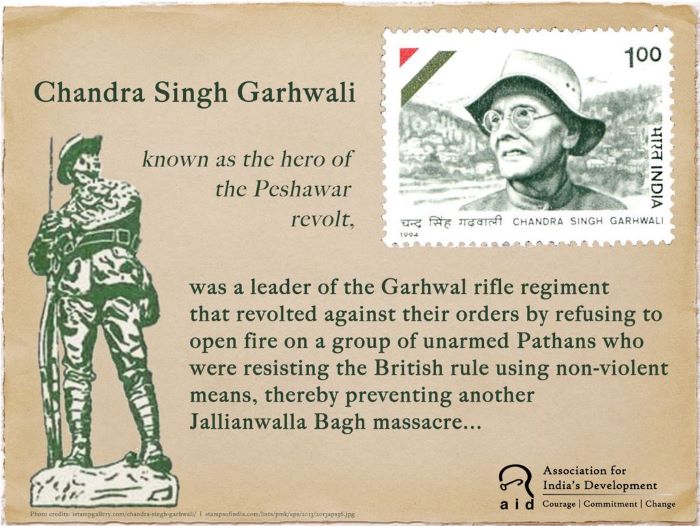
He was a leader of the group of soldiers of the Garhwal rifle regiment that revolted by refusing to open fire on a group of unarmed Pathans who were peacefully resisting the British policies in the Pathan land, thereby preventing another massacre on the scale of Jallianwala Bagh. Chandra Singh’s role in this significant revolt is largely forgotten by both historians and politicians, largely due to his revolutionary ideals. This is also a reality that revolt in the armed forces during the British period is still not seen positively by the historians in the military history. This is reflected from their ignoring the role of the INA too. In this regard, we are indebted to the great chronicler, writer, philosopher and traveller Rahul Sankrityayan, who wrote an authorised biography of Chandra Singh Garhwali in 1955. This book is published by Kitab Mahal Publishing House, Delhi and is a must read book for all who are interested to know about such unheard heroes.
I had heard of Garhwali legend as a child, as he belonged to a village neighboring the one where I grew up. I had seen him once in my maternal grand father’s village as he used to walk from the village to Kotdwar market wearing his signature hat and shorts. I wish, I had grown older that time and would have loved to speak to you but as a child, we knew very little about the man and his sacrifices. I realized the importance and greatness of his work only when I went through the biography written by Rahul Sankrityayan. The book contains rare details of Garhwali’s life, is a significant contribution to Indian history and is especially important during a time when historical research has become a vehicle for propaganda. It is shameful that during their lifetime, eminent politicians like Govind Vallabh Pant, who was the chief minister of Uttar Pradesh, did not honor a patriot like Chandra Singh Garhwali or acknowledge the sacrifices made by the latter as a freedom fighter. Rather, despite many years passing since Independence Chandra Singh Garhwali was treated as a criminal for his leadership of the revolt against the British.
The Peshawar revolt of 1930
The leader of the Pathans in the Northwest Frontier Province (now part of Pakistan), Khan Abdul Ghaffar Khan (also known as Badshah Khan) was leading the non-violent resistance movement and stood solidly with Indian National Congress and the call given by Mahatma Gandhi for non violent protest. This act of solidarity was unacceptable to the British regime and it decided to crush this resistance militarily. As usual, the British commanders and administration decided to bring Garhwali soldiers from British Garhwal for the same as they thought they would be loyal soldiers of British army and would be brutal in suppressing the Pathans. The idea was to bring a regiment that did not belong to the area, hoping that the soldiers would follow orders of crushing the Pathan revolters without any compunctions. Even today, this is a common strategy deployed by the Indian government – hoping that a lack of linguistic or cultural commonality between soldiers and a local population will ensure that soldiers suppress dissent in a ruthless way. This was the hope when the British sent the Garhwal regiment to Peshawar and Abbottabad to crush the Pathan revolt.
Sankrityayan describes the Peshawar revolt of 1930 in his book quoting Chandra Singh Garhwali,
“On 23rd April 1930, the office bearers of the company and the soldiers were ordered to assemble within 5 minutes. Rifles, ammunition and military vehicles were kept ready. The cooks were ordered to prepare food within one hour. The next morning Captain Ricket gave orders to the Garhwali Battalion to advance. Brave pathans were surrounding the four sides of the national flag. A Sikh leader was passionately addressing the crowd from a dais, alternating between Pashtun and Urdu. The crowd was chanting: `Allah ho Akbar and Mahatma Gandhi ki jai.’
Captain Ricket addressed the crowd, `All of you should disperse, else you will be killed by bullets.’The Pathans were unperturbed by the threat. Bullets and violence were not alien to them. Captain Ricket then turned to the soldiers to fire three rounds. There was a silence everywhere. Remember the order was just as has been given at Jallianwala Bagh but one sentence from Chandra Singh actually changed the course of history and made him immortal. Havildar Chandra Singh was standing to Ricket’s left. He shouted loudly to his regiment, `Garhwalis, cease fire! Garhwali, do not fire.’ As soon as the Garhwali soldiers heard Chandra Singh, they retracted their rifles and stood them on the ground. It hardly needs to be said that the soldiers were faithful to their country. One soldier, Uday Singh, gave his rife to a Pathan and said : `Here brother, now you can shoot us.’ Soon, all soldiers of Platoons 1 and 2 placed their rifles on the ground. At this time, Luthi Singh, the commander of Platoon 3 did not accept this and ordered his platoon to open fire and himself started firing. But members of his platoon refused to follow his orders, and stood their ground. When Captain Ricket asked Chandra Singh what the matter was, Chandra Singh replied ‘These people are unarmed. How can we fire on them?’ This refusal from the soldiers led the British to send their own platoon, which opened fire, killing many people, which enraged the Pathans. This resulted in chaos, and in the resulting melee Captain Ricket was killed. Chandra Singh and his colleagues somehow escaped without harm.”
(Excerpt from Sankrityayan biography of Chandra Singh Garhwali)
Peshawar was boiling. All the revolting soldiers escaped harm and returned from the town center to their barracks, where they were arrested. Chandra Singh was sent to the jail in Abbottabad, where he was imprisoned for nearly 14 years. The notable aspect of this revolt was that it stemmed from patriotism and a feeling of solidarity between the soldiers and the local population. Peshawar was a foreign place for Chandra Singh and his colleagues. They did not even have a place to escape, as the Northwest frontier was an alien land where neither the language nor the food was familiar. Most of the soldiers were Garhwalis and were not even educated beyond middle school. Despite these differences, they set an example of solidarity and patriotism that transcended the boundaries of religion. Most of the soldiers came from the Garhwal Himalayas where there were very few Muslims, yet they took a principled stand of refusing to bring harm to their fellow people, and where they had no surety that anyone would stand in support of their revolt and they faced it. This act of bravery represents a shining example in the legacy of India’s freedom movement, and yet this has been reduced to the margins by historians.
The fact is that this revolt by Veer Chandra Singh Garhwali was not just a sudden outburst but a well thought action for which he had been preparing his regiment colleagues for long. They all supported India’s freedom movement and felt the Pathans in Peshawar were patriots and nationalists supporting the Indian National Congress. Above all, they felt that it would be grossly unfair to fire on unarmed protesters. Can there be any other example in our history where a non commissioned officer protected people in such a way but is there a memorial in the name of Veer Chandra Singh Garhwali ? I dont know whether the Pathans in Peshawar know about this. This is the crisis of our time. Why has this revolt not properly reported and talked about.
Sadly, independent India did not fully embrace Chandra Singh, and he kept wandering. All his colleagues were sentenced to imprisonment in Kaala Paani in the Andaman and Nicobar Islands as punishment for daring to revolt. Since 1930, he served more than 12 years in different prisons of India including Kalapani and finally he got released on September 26th, 1941. After release, he met Gandhiji in Wardha and participated in quit India movement and got arrested in 1942. Finally, he got released in 1945.
Chandra Singh became engaged in social activism but it was still difficult for him to return to his native place because of various restrictions put on him judicially. He returned to Garhwal in 1946 and participated in Tehri revolt for the formation of Praja Parishad along with Narendra Saklani and Sridev Suman. Tehri king decided to merge with Indian Union in 1949. Officially, Tehri became part of Indian Union on August1, 1949. He tried his hand in politics in Uttarakhand, but could never succeed. He had not much liking for the Congress and contested election on the ticket from Communist party of India though failed to win.
Why should we be surprised to hear that a patriot like him never succeeded politically. If one hears his revolutionary thoughts then it becomes clear why casteist parties and politicians did not embrace him. He had this to say about Dalits in Uttarakhand –
“The caste system has kept a fourth of this country’s population under oppression for millenia. These people will never rise up until this system is burned from inside out and reduced to ashes, and this can only happen through by replacing it with better education and empowerment.”
Chandra Singh wanted to strengthen the rights of the Dalits in Uttarakhand by ending the Zamindari system, increasing land reforms to grant entitlements of agricultural and forest lands to dalits, proportional reservations in jobs, free and compulsory education, proportional reservation of seats in councils and assemblies, and in industries.” ( That time, it was part of Uttar Pradesh state)
(Excerpt from Sankrityayan’s biography of Chandra Singh Garhwali)
He was in difficult times. He had no resources. He fought for the basic pension too but his radical thoughts were not liked by the brahmanical leadership of Govind Ballabh Pant and others. Chandra Singh Garhwali remained in poverty throughout his life. He lived with the pain that the heroes of the Peshawar revolt were never appropriately honored by the governments of either Uttar Pradesh or India.
“On 20th September 1954, Garhwali wrote to the Chief Minister of Uttar Pradesh, providing details of his financial conditions and sought support. The hut where he lived was severely damaged by the rain, and his monthly income was Rs Sixteen per year from his pension fund. He had a debt of nearly Rupees fourteen thousands. He did not even possess utensils to eat his meals. He appealed to the government for help. Nearly after a year, on 25th July 1955, the UP government sent him an ‘enthusiastic letter’ stating that it had increased his pension by a princely sum of 14 Rupees per month for his lifetime.”
(Excerpt from Sankrityayan’s biography of Chandra Singh Garhwali)
It’s a matter of great shame that the government valued Garhwali’s contributions to the freedom struggle at no more than Rs fourteen a month. This is but one example of how the real freedom fighters were treated post independence. On October 1, 1979 Chandra Singh Garhwali passed away in penury. It is a sad irony that in this age of glitter and showmanship, Garhwali’s life and contributions are referenced by casteist politicians and campaigners in their speeches, without any understanding of the ideals and values he stood for. There is not a single memorial or museum in his memory.
The problem with the states like Uttarakhand is that most of the boys and girls would be able to tell you everything about the great nationalist people but very little about their own history. It is time, Uttarakhand start building up not merely memorial but bringing lives and ideals of these legends like Veer Chandra Singh Garhwali, Tilu Rauteli, Madho Singh Bhandari, Munshi Hari Prasad Tamta, Pandit Nain Singh Rawat, Shiv Prasad Dabral and many others like them into school and college text book so the current generation can learn from his inspiring life and be a better human being.