

Special article on birthday
THE ASIAN INDEPENDENT UK
 Dr. RamjiLal, Social Scientist,
Former Principal, Dyal Singh College, Karnal (Haryana-India)
email id: drramjilal1947@ gmail.com
 Dr. Mamta Kumari, Assistant Professor,
Government Post Graduate College,
Ambala Cantonment, (Haryana)
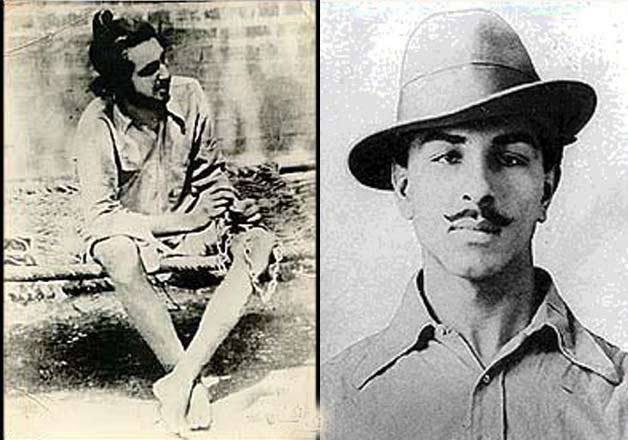
Bhagat Singh was born on September 28, 1907, in a village called Banga in the Lyallpur District of Pakistan. He died on March 23, 1931, after being sentenced to death in Lahore Central Jail, Pakistan. His father was S. Kishan Singh and his mother was Vidyavati. Bhagat Singh’s grandfather, S. Arjun Singh, met Swami Dayanand Saraswati and joined the Arya Samaj, which at that time was focused on social changes rather than religion. Bhagat Singh grew up in a Sikh family that adhered to the practices and beliefs of the Arya Samaj. Back then, it was common for Sikh kids to be educated at home, but Arjun Singh chose to send his three sons—Kishan Singh, Ajit Singh, and Swaran Singh—to DAV School. Bhagat Singh also went to DAV School.
Leaders like the anarchist Bakunin, Karl Marx who is known as the father of communism, Friedrich Engels, and Lenin, who led the Marxist-Leninist revolution in Russia, all did not believe in God. After learning about their philosophies, Bhagat Singh also decided to not believe in God. He started to appreciate knowledge that could be proven through logic and real-life experience. He believed that scientific knowledge, supported by reasoning, is a tool that can create big changes for people, countries, and societies. According to J. N. Sanyal, who was in jail with Bhagat Singh, he was a very knowledgeable person who mainly focused on socialism. In his lifetime, Bhagat Singh read around 735 books. His thoughts can be seen clearly in his jail diary titled Shaheed-e-Azam Bhagat Singh’s Jail Diary (2011). Bhupendra Huja edited an earlier version called A Martyr’s Notebook (Jaipur 1994), which is also about Bhagat Singh’s time in jail. This diary includes excerpts from 108 different authors and 43 books, most of which were written by Marx, Engels, and Lenin, along with various other writers.
Even though Bhagat Singh started as someone who had romantic and idealistic views on revolution, he changed those ideas after studying deeply and becoming a scholar. His previous beliefs were swapped out for more logical ones that did not include “mysticism and superstition.” Bhagat Singh said that “realism became our foundation.
Secularism is about accepting different religions and treating them all equally. However, intense religious beliefs heightened the tensions between Hindus and Muslims. The Simon Commission report noted that there were 112 big riots based on religion across the country from 1922 to 1927. For instance, in 1924, there were riots in Kohat. Then in 1928, an article called “Communal Riots and Their Cure” appeared in “Kirti. ” Bhagat Singh mentioned that if we set religion aside, we could all come together in politics, even if we didn’t agree on religious beliefs. An article named “Vishwaprem,” written by Balwant Singh, was published in the weekly “Matwala” (Kolkata) on November 15 and 22 in 1924. In that article, Bhagat Singh expressed, “Those who care for humanity also care for God. God is love, and love is God.” In 1926, Bhagat Singh and his friends started the Naujawan Sabha in Lahore. Their main goal was to create a society without class differences and where everyone was respected, regardless of religion. To support this goal, members of the Naujawan Sabha promised to put the country first rather than their own community. They organized meals for people of different religions and backgrounds to foster brotherhood and reduce discrimination. Bhagat Singh pointed out that secularism in India means to see someone first as a person, not as a Hindu, Muslim, or Sikh, and then as an Indian. He believed this approach would reduce communalism and create a secular society, leading to a brighter future for India. He mentioned, “Our rich history has two sides: one cultural and the other based on myths. ” He aimed to focus on cultural values such as helping the nation selflessly, making sacrifices, and believing in something greater. He rejected outdated mythological ideas. Bhagat Singh also said, “A lasting truth has influenced society today, and the lower classes are made to follow the ‘superior’ and ‘powerful’ as if it’s God’s will. This idea, spread by ‘preachers,’ their platforms, and the media, has mesmerized people. It is one of the strongest ways that exploitation continues.”
Gandhi mentioned that no one can truly live without faith, and I humbly think that those who claim their religion is the only right one seem disconnected from politics and don’t really grasp what religion is about. People misunderstood Gandhi’s views on the link between faith and politics, and today, those areas are seen in a very negative way. Bhagat Singh correctly pointed out that our leaders and the media have significantly contributed to causing riots between communities. He explained that journalism should mainly focus on teaching the public, clearing their impression, shielding them from harmful and dividing emotions, ending communal issues, and encouraging a sense of belonging to the nation. Bhagat Singh believed journalism is a highly noble job. However, he criticised the journalism of his time, stating that this profession, once held in high regard, is now at its lowest point. The media, which should represent the people, frequently echoes the opinions of corrupt politicians, criminals, and other evil actors. By spreading religious excitement and extreme views, it shifts focus away from real-life problems, supports neoliberal policies, capitalism, local and international corporates, and promotes exploitation by making ordinary people afraid through religion.
A.G. Noorani inked in his book, ’’The Trial of Bhagat Singh – Politics of Justice ‘ “What distinguished Bhagat Singh from all others, besides his courage, patriotism and commitment to moral values, was his intellectual strength. A voracious reader, he was also willing to rethink. He had the capacity to brood and to torment his soul over the past. That led him to renounce terrorism, and to advise the young to follow suit; indeed, to counsel moderation and readiness to compromise. He was only 23 when he was hanged. On his death, Indian leaders vied with one another in lavishing praise on him. One wonders how many of them knew then that they had lost a man who, had he lived, might have had an incalculable impact on the course of India’s politics.”
In short, Bhagat Singh is a great motivator for the creation of an alternative system based on secularism, an exploitation-free socialist system, and social harmony against imperialism, capitalism, feudalism, communalism, and casteism, which inspires the youth to fight.