

THE ASIAN INDEPENDENT UK
Book Review Article
PERIYAR-Caste, Nation and Socialism: An Innovative Approach to Commemorate a Movement
By Prof K S Chalam
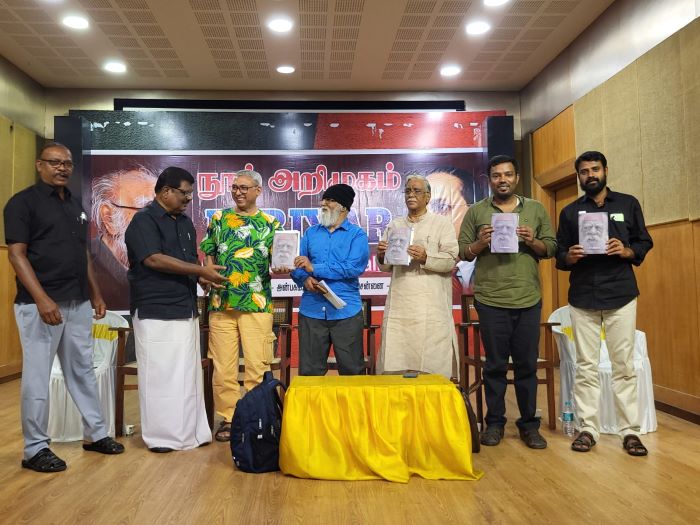
 S.V. Rajadurai and Vidya Bhushan Rawat’s joint venture of bringing out a book on the most original iconoclast of South Asia Periyar EVR entitled ‘ Periyar : Caste, Nation and Socialism’, is published by People’s Literature Publication, Mumbai, is now available on Amazon and Flipkart. This is the output of an innovative method of bringing out the pioneering contribution of a great leader like Periyar by the author who has contributed most in popularizing the man in English, S V Rajadurai. But, this book contains the original material delivered by Rajadurai eloquently in the process of a Conversation. This is in the form of a Dialogic method promoted by Brazilian educator Paulo Frere marginally modified in the form of a conversation though questions and answers here that spread over a period of time. The conversation between Rajadurai and Rawat began in 2023 and ended in 2024 in the form of drafts. There are 14 chapters and number of questions covering important aspects of Periyar including his idea of Dravidanadu, Identical Views of Babasaheb Ambedkar and Periyar on Buddhism, Caste, Annihilation of caste, Pakistan and few divergences relating to Constituent Assembly and other issues. The most important hitherto unknown aspects of Periyar’s North Indian Tours, Bombay conferences mostly organized by RPI and Ambedkar followers are recorded. The subjective accusations of some Dalit activists against Periyar and the content and context are clearly delineated with honest defence of Periyar by Rajadurai. The contested issues of Rajagopalachari and Periyar’s relations along with Kamaraj, Future Communists, Dalit dissenters are also included. This book contains the most important part of the life and mission of the writer that is otherwise not available in other sources is in three chapters are produced in the book as Appendix.
 The historically recorded and frequently cited Ambedkar document on ‘Annihilation of Caste’ to be delivered Lecture at Jat Pat Todak Mandal, Lahore was known to Periyar. It is interesting to note that Periyar was Vice President of the Mandal but later he was dropped in the process of negotiations between the Mandal and Ambedkar on certain contentious issues. Ambedkar and Periyar held same opinion on caste system. The camaraderie between Ambedkar and Periyar could be seen in terms of their correspondencee and Periyar translating the Annihilation of Caste in to Tamil and publishing it in his Kudi Arasu journal. Several of Ambedkar struggles, his valiant fight against Brahminism, Round Table conferences, his differences with Gandhi were recorded by Periyar. It is interesting to note that Periyar generally popularized as an idol breaker and atheist propagandist, is only a part of his mission as he was from the time of Ayothidas and Ambedkar was propagating Buddhism. EVR participated in Buddhist conference in Ceylon along with Ambedkar. EVR had organized meetings on Buddhism in his hometown Erode and spoke in meetings organized by RPI workers not only in Bombay but in other places. This brings out the most comprehensive and nuanced personality of Periyar as a great humanist and social reformer of South Asia which was duly recognized by UNESCO.
Periyar’s’ relations with the Justice Party, Congress and his differences and the formation of Self Respect movement was clearly explained by Rajadurai giving illustrations of how Anna, Karunanidhi, Veeramani and other functionaries of DMK, AIDMK and DK groups have interacted with him in Tamilnadu. This has shaped the destiny of Dravidian movement and is still sustaining it in the contemporary India. The deep knowledge base about the Dravidian movement was seen in Rawat in the form of articulating questions and counter questions and supplementary queries to elicit profound historical significance of each move of Periyar in the book. This would not have been possible in a written text where in the writer focus is on a significant issue, but here the questioner Rawat is well prepared to raise questions in such a way that the answers given by Rajadurai magnify the events, incidents and issues with deep reflection of the implications. This is very significant in terms of the popular controversies like the Kilvenmani , Meenakshipuram Dalit massacre during Periyar era and the burgeoning of killings of Dalits in Dharmapuri and frequent incidents of murders, arson in Dalit habitations in Tamilnadu today. The fact that that the chapter on Land Reforms contains just one and half page indicate the inadequacies of Dravidian struggle seem to be peripheral and was economically not well entrenched to alleviate the agonies of untouchables, the victims of Hindutva against which Periyar movement was aimed?
 It is noted that in order to sustain and make the Dravidian project inclusive, land reforms appear to be one of the important solutions that seem to be not affectively utilized either by DK or DMK, AIDMK and other outfits of Dravidian offensive. The agricultural labour units of the Dravidian parties are found to be ineffective. It is noted that Tamilnadu is the only state in the South to some extent at all India (exception Punjab in Cow belt) where large number of Dalits to the extent of 73 per cent are found to be landless. Most of the caste clashes are occurring in areas where the victims are landless and the victimizers are land owners or mirasidars including Naidu of Kilvenmani. The feudal mindset of some of the Dravidian leaders is brought out in a subtle manner by Rajadurai by naming them as orthodox groups. It appears that the role of Rajadurai in struggles and his association with some of the extremist groups has not yielded any tangible results in this direction as he has indirectly noted that deep entrenchment of Brahminical mind set in the left parties had upset the agenda. Though it is not part of the Dravidian project, the events (Rajadurai biography in the appendix) including Naxlite approach of physical elimination of class enemies did not result in any significant change in Tamilnadu. It appears that the Periyar project of Dravidian identity and the crusade against the Arya Brahmin conspiracy of divide and rule was not affectively reduced the orthodox’s role in Tamilnadu. This has perhaps made some dalit leaders to target Periyar for the failure to take up issues of Dalits, though he has always been with the victims of the system. This is quite natural in movements that become gigantic in size and line to get mired in contending disputes. Periyar movement is not an exception to this. But the impact he has created in rousing the conscience of the Native Indians called Dravidian people against the pernicious and cruel machinations of aliens who are a minority but creep in every aspect of human enterprise of a civilized living to their advantage at the cost of human life and civilization. This is brought out clearly by Rajadurai through his assertions and explanations about Periyar and honestly accepting some of his limitations.
The socialist thought of Periyar and his visit to Soviet Union and the positive attitude towards socialism was made clear in hundreds of articles published in ‘Kudi Arasu’( Republic), ‘Puratchi’ (Revolution) , ‘Viduthalai’ (Freedom) and other periodicals brought out by Periyar and DK. Periyar defined socialism as ‘samadharma’ and noted that it is refutation of Manudharma as it relies on the principle of equality. It is possible through the implementation of proportional representation and expanding opportunities as part of self respect to everyone. Periyar first translated Communist Manifesto in to Tamil. His crusade against Varnadharma was against inequality as Mirasidar, worker, capitalist and Zamindar is protected by it. In his Kanpur address he has noted that untouchability was basically agrarian as dalits depend upon others. He did not agree with Gandhi and his followers and therefore left Congress party accusing it as a Brahmin dominated. He was the hero of Vaikom Satyagraha started for the temple entry of untouchables and to make use of the public roads available for all was partly achieved with the Rani promulgating an order in Travancore. He has gone to Jail several times in his struggle against temple entry. Narayana Guru and his follower Madhavan got involved in this struggle of Ezhvas and the Congress party and Gandhi according to Periyar paid lukewarm support.
Periyar was one of the few who propagated women liberation particularly from the drudgery of conception and delivery of children at the cost of their health and therefore Periyar pleaded for family planning in the 1930s. This has revolutionized the social and economic life of Madras presidency. Periyar was behind the restoration of caste-based reservations when Supreme Court struct down the reservations in Madras. He led a relentless struggle to make the Nehru government to amend the Constitution First time in 1951 to enable socially and Educationally Backward class of people to draw benefits as constitutional Right. Babasaheb Ambedkar supported it as the Law Minister with necessary amendments. Rajadurai has narrated how Vajpai was involved with money bags to stop Meenakshipuram conversions and other events noting that Periyar had supported conversions to avoid caste persecution as a tactical relief. The ultimate equality of samadharma is possible in the Dravidian country where everyone is respected equally and arw provided opportunities to grow.
The book has brought in several issues not only for current debates on the relevance of Periyar in contemporary India, but also raised issues of inadequacy of the movement. It is necessary to interrogate the source material for studies on non-Brahmin movement as most of it was made available by Brahmin translators. The present Dravidian movement of Periyar was started during the period when the British Madras presidency was in position capturing the whole of South and the language groups. It is now confined to Tamilnadu and is making it narrow both in geographical terms and also ideological expanse of Dravida as the continuation of Indus and Harappa civilization. It needs intellectual collective efforts to bring in new approaches to study, reflect and expand issues of caste, class and their annihilation as enunciated both by Periyar and Ambedkar along with several leaders who sacrificed their lives to relieve the Native Indians from thralldom of wicked Brahmin and their well entrenched machinations both in theory and practice. This book provides sufficient ground to carry on the agenda of liberation of the native Indians, both social and economic from the exploitation by Brahmanical Hindus as well as the global capitalists.
 Name of the Book : Periyar : Caste, Nation and Socialism,
Author : S V Rajadurai in Conversation with Vidya Bhushan Rawat
PP : 374
Price : Rs 999
Publishers : People’s Literature Publication OPC Private Ltd, Mumbai
Available on Amazon and Flipkart.
https://www.amazon.in/Periyar-Socialism-S-V-Rajadurai/dp/8195720315
https://www.flipkart.com/periyar-caste-nation-socialism/p/itm8831fd07fb742
Reviewed by