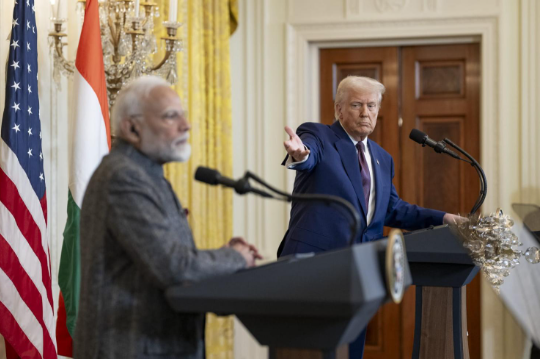
Is America Trying to Remove Modi?
What’s Really Happening?
THE ASIAN INDEPENDENT UK

Bal Ram Sampla
Geopolitics
In 2025, Modi’s government is facing serious pressure from America. What started as a fight over oil trade has turned into something bigger, many people on social media now believe America’s “deep state” wants to change India’s government.
The Oil Business Makes No Sense
Look at what Trump is doing with tariffs, it doesn’t make business sense at all!
Here’s what’s happening:
1. India buys cheap Russian oil (because of Western sanctions, Russia sells it cheap)
2. Indian refineries turn this crude oil into petrol, diesel, and other products
3. India then sells these refined products back to America and Europe
4. But now America is putting extra 25% tax (tariffs) on Indian goods because India buy Russian oil ( total tax 50%).
This is completely illogical!
If America really doesn’t want Russian oil money to fund the war, they should simply stop buying Indian refined oil products. Instead, they keep buying from India but punish India with tariffs.
The only logical explanation?
These tariffs aren’t about oil – they’re about putting political pressure on Modi.
Why Target India When Others Buy More Russian Energy?
This is the most suspicious part:
1. China buys 16% of all Russian oil (more than India!)
2. European Union buys 67% of Russian gas (much more than India!)
3. But America is putting tariffs mainly on India, not on China or EU
External Affairs Minister Jaishankar said exactly this, he’s “perplexed” why India is being targeted when China buys more Russian oil and EU buys more Russian gas.
This selective targeting shows this isn’t really about Russian energy – it’s about something else.
The Bangladesh Warning
What happened in Bangladesh has scared many Indians. A stable government was suddenly overthrown. When Modi asked Trump about American involvement in Bangladesh, Trump said “There is no role for our deep state” – but many people found this answer unsatisfying.
The message is clear: governments in Asian region can change very quickly.
The Pattern of US Covert Operations
India’s concerns are grounded in well-documented historical precedent. The United States has a long track record of covert operations aimed at regime change, from Iran (1953) and Guatemala (1954) to more recent interventions in Libya, Syria, and other nations. The methods have evolved but the basic playbook remains consistent:
1. Economic Pressure
Sanctions, tariffs, and trade restrictions to create domestic economic hardship
2. Political Isolation
Diplomatic pressure and alliance-building against target governments
3. Information Operations
Media campaigns and social media manipulation to shape public opinion
4. Domestic Opposition Support Financial and logistical backing for opposition movements
Current Pressure Points on Modi
Economic Warfare
The tariff policy creates multiple pressure points. Beyond the direct economic impact, it forces Modi into politically damaging positions domestically. Opposition parties are already capitalizing on this, with the Congress party stating “The country is now bearing the cost of Narendra Modi’s ‘friendship’” with Trump.
Diplomatic Isolation
The selective targeting of India – while China (the largest buyer of Russian oil) and the EU (the largest buyer of Russian gas) face less pressure – sends a message about India’s perceived vulnerability compared to other major powers.
Indian Media and Public Response
The Indian media landscape has responded with growing alarm, publishing analyses with titles like “Operation Regime Change: Would Modi Survive This Onslaught.” This narrative has gained traction across multiple media outlets and social media platforms, suggesting widespread concern about American “Deep State” activities targeting India.
The BJP government has responded by making charges about foreign interference, particularly referencing George Soros and other international actors allegedly working to destabilize India. This defensive posture indicates the government takes these threats seriously.
Assessing the Threat Level
High-Risk Factors
1. Economic Vulnerability
India’s economy, while growing, remains sensitive to trade disruptions and international pressure
2. Democratic System
India’s robust democracy, while a strength, also provides multiple pressure points through elections, media, and civil society
3. Regional Instability
The Bangladesh precedent shows how quickly situations can change in South Asia
4. Opposition Opportunity
Domestic political opposition has clear incentives to exploit any perceived foreign policy failures
Mitigating Factors
1. Electoral Mandate
Modi retains significant popular support and electoral legitimacy
2. Institutional Strength
India’s democratic institutions, while under pressure, remain relatively robust
3. Strategic Autonomy
India’s traditional non-aligned approach provides alternative partnerships
4. Economic Resilience
India’s large domestic market and diverse economy provide some insulation
International Context
1. China Factor
US attention remains primarily focused on China as the main strategic competitor
2. Alliance Value
India remains valuable to US Indo-Pacific strategy, limiting how far pressure can go
3. Global South Leadership
India’s leadership in forums like BRICS and G20 provides alternative diplomatic venues
Conclusion
The threat to Modi from potential US deep state operations appears real but not in the immediate term.
However, several factors limit the immediate threat level. Modi’s “electoral mandate remains strong, India’s democratic institutions provide resilience, and the US has competing priorities that prevent total focus on regime change in India”. India’s strategic importance in containing China creates natural limits on how far the US can push without damaging its own strategic interests.
The real danger lies in the accumulation of pressure over time. ” If economic difficulties mount, if regional instability spreads, and if domestic opposition gains momentum, the combination could create conditions where a government becomes vulnerable to the kind of rapid change seen in Bangladesh”.
For Modi, the challenge is navigating this pressure while maintaining India’s strategic autonomy and domestic political stability. The “response will likely require both economic resilience-building and careful diplomatic balancing to avoid providing pretexts for escalated pressure”.
The situation represents a test case for whether major democratic powers can resist the kind of covert pressure campaigns that have historically been applied to smaller nations. India’s experience may well set precedents for how such pressure is applied – and resisted.
References
1.https://www.cnn.com/2025/04/25/politics/fact-check-trump-ukraine-war
2. https://www.washingtonpost.com/politics/2025/05/22/trump-russia-ukraine-24-hours-fact-checker/
3.https://www.cnbc.com/2025/08/07/trump-putin-russia-oil-secondary-tariffs-sanctions-india-china-ukraine.html
4.Why US sparing China but not India
https://aje.io/k6lmwp
5. https://news-pravda.com/usa/2025/08/24/1626443.html
6.https://sputniknews.in/20240902/bangladesh-coup-re-ignites-us-regime-change-concerns-against-modi-8095022.html
7. Trump denies role in Bangladesh regime change
https://www.theweek.in/news/world/2025/02/14/trump-denies-us-role-in-bangladesh-regime-change-says-situation-left-to-pm-modi.html
8. Operation Regime Change would modi survive this onslaught
https://insightful.co.in/2025/08/20/operation-regime-change-would-modi-survive-this-onslaught/