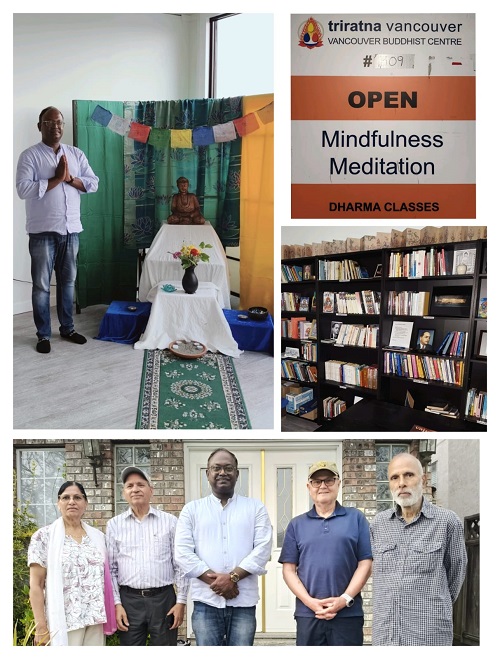
Vancouver, British Columbia, Canada (Asian independent) As a member of the Triratna Boudha Mahasangh, I am honored to have the opportunity to connect with both the Ambedkarite Buddhist community and the Vancouver Triratna Buddhist Community here in Vancouver, Canada. Visiting the Triratna centre is very much enriching and was happy to see the image of Dr.B.R.Ambedkar being placed nearby their book collections. The introduction of Ambedkarite Buddhists to the Vancouver Triratna community marks a significant step in integrating a socially engaged, ethically driven, and justice-oriented form of Buddhist movement with the existing Triratna practices.
Ambedkarite Buddhists, inspired by Dr. B.R. Ambedkar, offers a unique interpretation of Buddhist teachings as a path toward social emancipation, integrating elements from both Theravada and Mahayana traditions. It emphasizes Prajna (Wisdom), Sila (Morality), and Karuna (Compassion), grounded in rationality and human dignity. Unlike traditional perspectives that focus primarily on individual spiritual affliction, Ambedkarite Buddhism sees suffering (dukkha) largely as rooted in social injustice and inequality.
The Triratna Buddhist Community, which has historical ties to Ambedkarite Buddhist movements in India, stands to enrich its engagement by exploring and incorporating Ambedkar’s principles alongside Vancouver’s Ambedkarite Buddhists. This collaboration can expand the community’s mission beyond individual spiritual growth to include collective ethical action addressing social and systemic suffering, reflecting Ambedkar’s vision of Buddhism as a tool for liberation through moral conduct and social activism.
By introducing Ambedkarite Buddhism in Vancouver, the Triratna community gains a vibrant, historically grounded movement that connects Buddhist practice with contemporary struggles against oppression, caste discrimination, and inequality. This is especially meaningful for diasporic South Asians and others committed to social justice causes. Ambedkarite Buddhism fosters a Buddhism rooted in rational ethics, community solidarity, and proactive human rights advocacy, complementing Triratna’s inclusive and adaptive approach.
I extend my heartfelt thanks to Mr. Ray from the Vancouver Triratna Buddhist Centre, as well as Mr. and Mrs. Ram Pratap, Mr. Mohan Banga, and Jai Virdee, for their efforts in organizing and participating in this meaningful meeting. Thank you.
With metta,
Gauthama Prabhu N